New Fungi species plus the Amphibians are back in town

2024 continues to get off to a slow start, with the rain rarely letting up here in Bristol, although it has been relatively mild. We did however record a new fungi in the the Garden. The rather gothic looking Blushing Bracket fungus, alternatively known as Daedaleopsis confragosa, growing from a cut branch. An amazing looking fungus, blackening off as it ages.
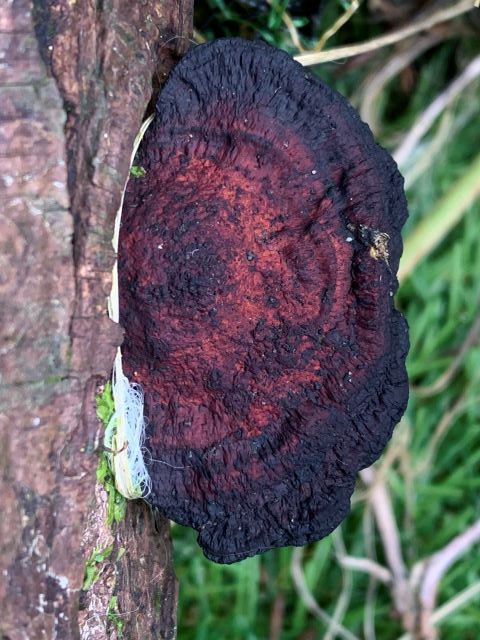
Blushing Bracket – 4th February 2024

And the frog chorus began on the same day we recorded the above, 4th February. By the 10th February we found our first frog spawn of the year in the fish pond.
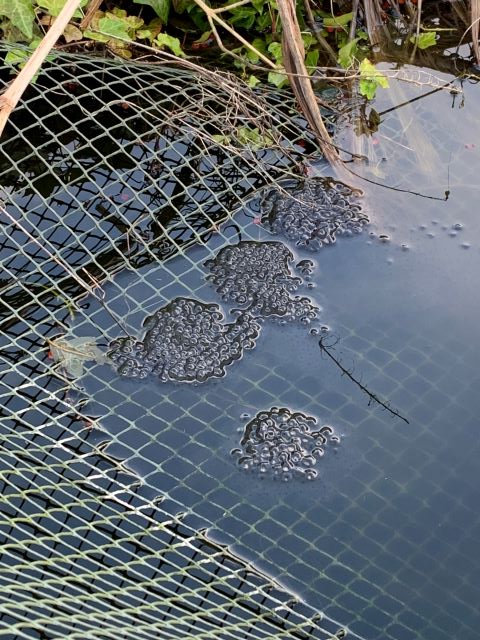
Frog Spawn in Fish Pond – 11th February 2024

Our new wildlife pond on the middle level of the Garden is making slow progress, mainly on account of the weather but also the amphibians themselves. Frogs started arriving in January and we have recorded our first newt since 2021. We only got a quickish look at it, but suspect it was a male palmate newt. It was under a fold in the new pond liner, as was a breeding pair of frogs and another male frog on its own (still no sign of toads). So we are having to pause working on things until we are sure we wont harm any of our amphibian friends. We were however able to create the small beach area shown below…
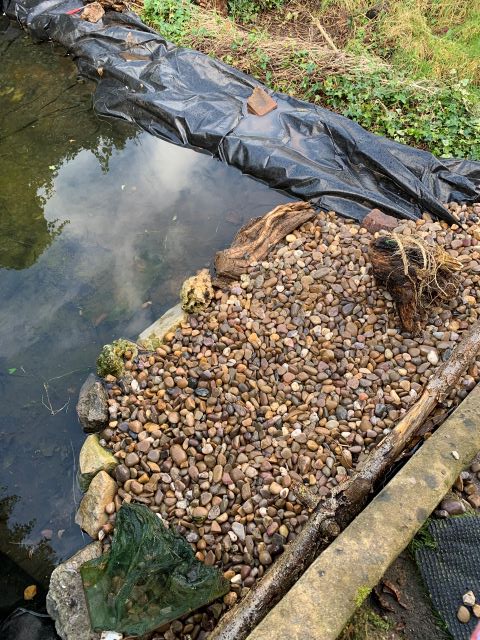
Small pebble beach area – 11th February 2024

Our January diary page is now in the calendar, but really there was nothing much to report other than to confirm the new moss spotted in the meadow area, noted in our post of the 2nd January, we believe belongs to the genus Fissidens, click HERE. The plan as stated is to wait to see if it can continue to establish and grow, allowing us to take a sample and check it out under magnification.
Another species of Springtail

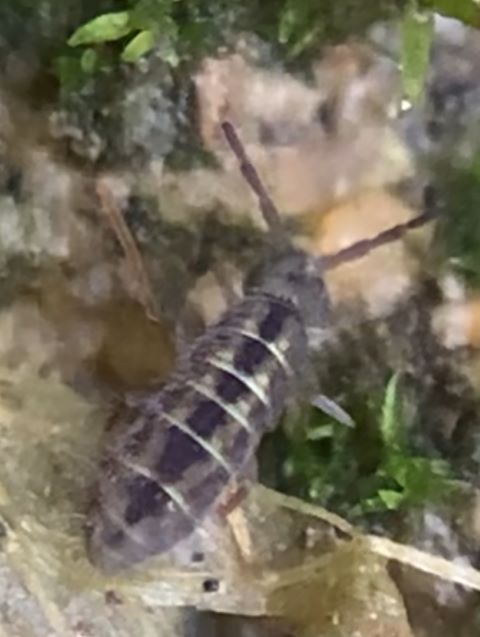
Our Springtail species list hit double figures with the following species, we think belonging to the genus Isotomurus, recorded yesterday. We suspect it may be Isotomurus maculatus, but there is just enough doubt in our minds not to record it to species level.

It was recorded heading towards a large clump of moss. Moss being where nearly all the other Springtail species we have recorded seem to exist. What we liked about this little fella was it wasn’t actually that little, we spotted it scurrying about as we walked up the concrete steps. So we would guess larger than many species, although still of course tiny.

5th February 2024

You can view the other springtail species rcorded in the Garden on our Springtail page HERE. If you want to find springtails in your own space, then we would recommend using some form of magnification. Nothing fancy, a magnifying glass/hand lens would suffice, and just examine some moss, damp soil, rotting leaves. Springtails are one of the most abundant forms of animal life we have and very species diverse. And fun to watch…

DC: 6th February 2024

Big Garden Bird Count

Last weekend we decided to take part in this years Big Garden Birdwatch, an RSPB survey conducted every year at the end of January. The general idea being that for each species you record, you note the maximum number of that species you see landed in your garden at any one time. This hour can be anytime of day between 26th and 28th January in 2024.

We chose an hour that suited us, 10:15am to 11:15am on the 28th. Whilst this may have been a good time for us, it’s not a great time of day for observing birds. And so it proved to be, only two blue tits were seen within the boundaries of our garden during the whole hour. Both at the same time flittering between or Hazel tree and next doors buddleia.

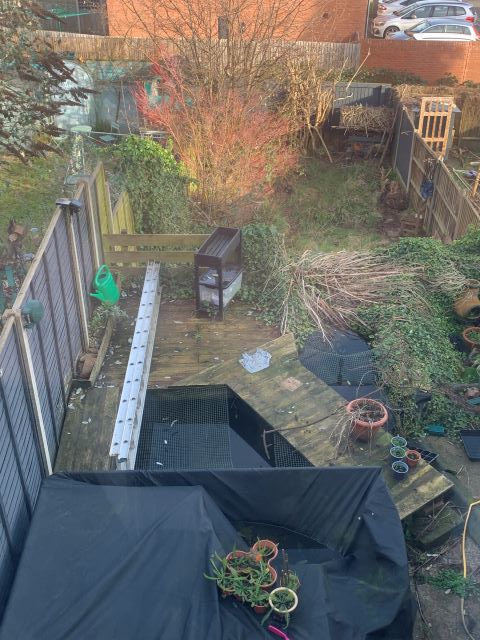
Day of the Big Garden Bird Count 28.01.2024

So a little disappointing, especially as can be seen in the image above, the sun was out and the skies clear. The blue tits did stick around for about 8 minutes before departing. But other than a few crows seen in the distance and some gulls flying overhead, we didn’t really see any other birds at all.

This national survey has been going since the 70’s and sadly records some worrying declines in many bird species. Check out the RSPB’s website for more information.

DC:03/02/2024

Another Coprinellus species (or the same one?)

The weather was mostly dry today so a quick nose in the Garden was in order and whilst shifting some cut branches about we came across the following…

…which we can only describe as a fungi doing an impression of an acorn. But fungi they clearly were, however being only partially emerged we didnt expect to be able to identify them. We also came across the following on another branch next to this one…

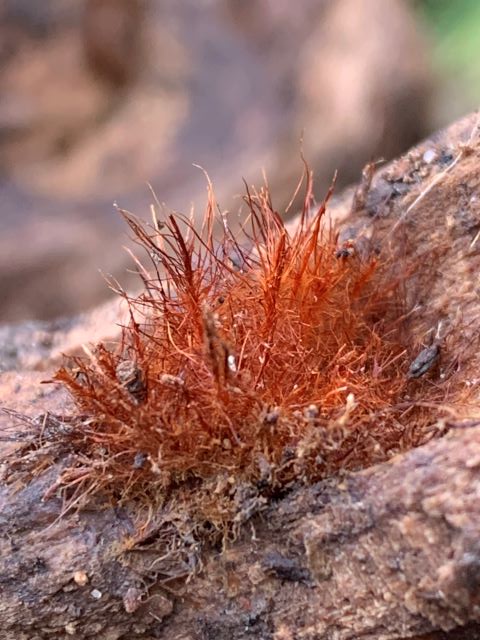
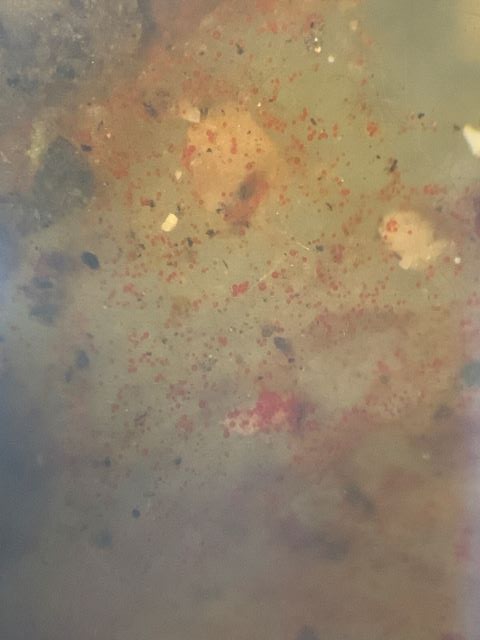
…and have to admit our initial thought was we had found a red moss of some sort. Both these images seemed unusual enough to be worth running through one of the many identification apps available to download these days.

The first images came back with a genus level result, suggesting our fungi belongs to the genus Coprinellus, which if you read our 2nd January post, was the genus to which our first new species of the year belonged, Coprinellus micaceus. We naturally assumed that the two records were of the same species, having grown from the same dead plant. However, when we ran the second image through the ID app it came back not with a moss (or a slimemold, or a lichen) but with a fungi species identification, Coprinellus domesticus, otherwise known as the Firerug Inkcap.

We checked our fungi guide and it seems the second image above is of something called ozonium, which some species of fungi produce. It’s a mat of hyphae like growth that occurs outside the substrate (deadwood in this case) and from which the fruiting body (mushroom/toadstool) grows. The problem for us now is that both Coprinellus species listed above apparently produce this ozonium. So we may have one species or two. Our best bet is to wait to see what the new mushrooms look like, as the fruiting bodies are different. Both are common.

We had never come across the term ozonium before and although we think we have seen it before we probably never considered it to be part of a fungus.

DC: 14.01.2024

Daddy Longlegs

In most parts of the country the insect we refer to as a Daddy Longlegs is one of a number of similar looking flies called Craneflies. Although some people also call Harvestmen, arachnids rather than insects, by the same title.

We very recently (24th December 2023) uploaded a video to you tube showing what a Cranefly Larva looked like, known by some as a leatherjacket. In effect a Baby Daddy Longlegs. We were examining some moss when we noticed it moving about. Not exactly cute…

As it happens, we came across a Cranefly on the Garden steps today (2nd January 2024), that appeared to be a) dead and b) floating. Confused, we got up close and after a few seconds realised that the little guy was neither dead or floating, in fact quite the opposite. It was a newly emerged adult, still attached to the larval casing which was hidden from view underneath in the moss where it no doubt spent the first stages of it’s life.

At about 18 seconds in you can see we filmed the side of the Thorax to confirm the presence of a black stripe, which hints strongly at this being Tipula rufina. A species we see regularly in the Garden.

Many people are a little scared of Craneflies, which seeing as there are over 300 different species in Britain is a little unfortunate. Some say this is because they look a little like flying spiders. Of course no spider exists that has wings and Craneflies are totally harmless to humans. Many lack the ability to feed. However it may just be the way they move about, clumsily bumping into everything, especially people and especially their hair.

The greater the diversity of habitats within your garden and by extension the species they support, the greater will be your chances of observing many of the important life cycles/stages of the animals and plants that share our gardens and homes. Which makes Gardens so much more interesting, if you take the time to look.

DC: 02/01/2024

First new species record of 2024

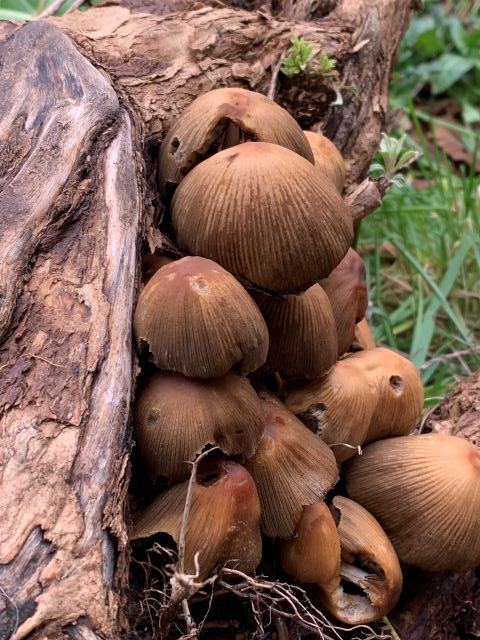
Nature, as we know, is pretty amazing. You don’t have to wait long before something new comes along to surprise you, making encouraging, observing and recording wildlife so rewarding. This proved the case yet again on new years day 2024 when out in the Garden we spotted a new species of fungi, our first new Garden species of the year. Check this clump out…

We believe this to be Coprinellus micaceus, which is a very common fungi associated with deadwood. In this case the dead wood in question was the Buddleia stump we removed when prepping the middle level of the Garden for the new pond (see our September 2023 diary entry HERE).

Wikipedia has lots of information on this species so worth checking out. We were particularly interested to note it prefers to feed off the bark of the plant rather than the wood itself. The bark of buddliea is very brittle and seems to take years to rot down, so hopefully this fungi is helping to speed up this process. Nature tidying up after herself again.

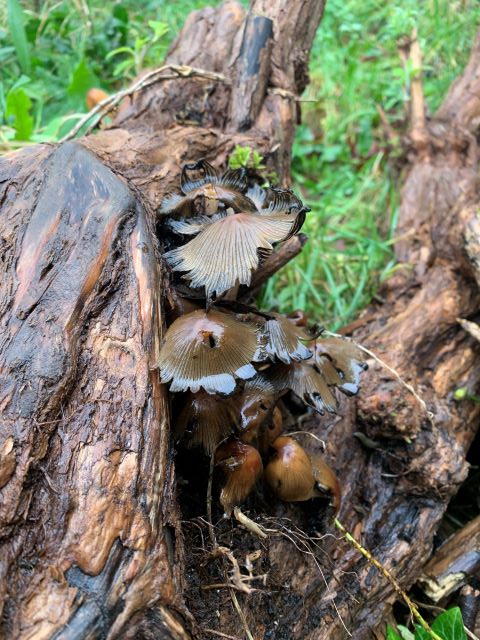
C.micaceus belongs to a group of fungi referred to as the Ink Caps, and for very good reason. By the next day our clump above looked like this…

Ink
2nd January 2024

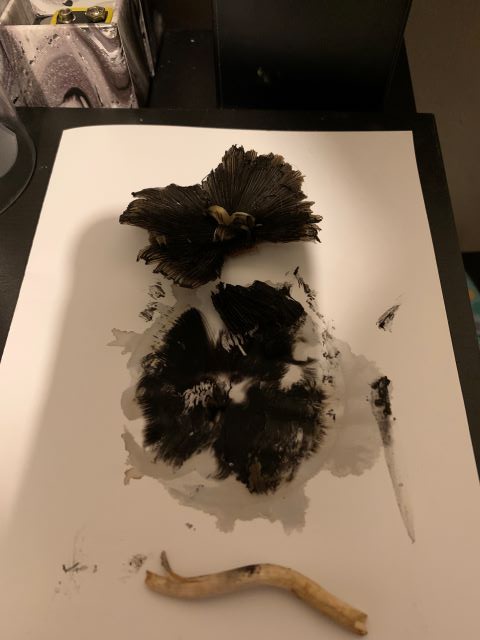
This species is known to be delicate and disintegrates freely. We attempted to get a spore print from it but the mushroom we had was too far “over” and the following was the result, more mush than spore.

spore print attempt

A spore print is when you take the head of a ripe, but not over ripe mushroom and place it gills down on a piece of white paper, having first removed the stem. After a day or so, if all goes well, the spores will have fallen from the gills and created a pattern which, along with the spore colour, can help identify the species.

It seems likely that this wasn’t the only new species recorded on new years day. A unknown moss was spotted growing on the soil surface. We think we know the genus but will try and get a species ID.

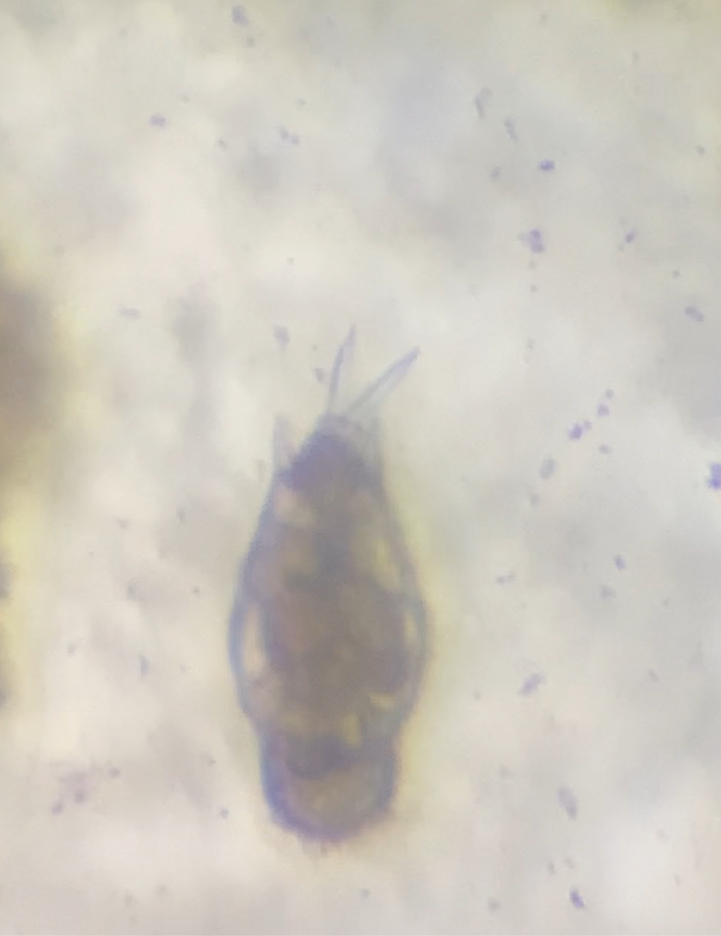
Our December / final diary entry for 2023 is now on our diary page (see HERE). You’ll note we recorded two species of Rotifer to genus level during December. We can confirm we have now added a third Rotifer to our list, in the form of a Mytilina spp, click HERE for details. The image below we appreciate is poor, but these are very common organisms so we should be able to get something clearer.

Note: As Rotifers are a whole new Phylum of animal for us, we may take a while building up the relevant page to provide more information on these rather interesting micro-organisms.

DC: 02/01/2024

Being tiny changes everything!

We recently recovered a small petri dish mistakenly left outside for several months gathering rain. Rather than just wash it out we decided first to see what had colonised the dish during this time.

Algae

We could already see that lots of algae had formed throughout the dish. Lots of detritus had also arrived as well. But to get a really good look would require magnification…

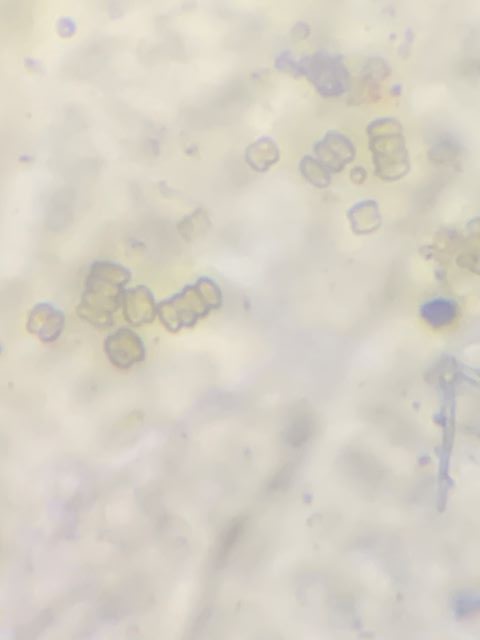
Under magnification (x100), we could see the individual algae cells. In this case a green algae which mainly appeared in sets of 4 cells, sometimes fewer but never more. This is somewhat similar to a species called Scenedesmus quadricuada.

Algae Green

However, it was the unexpected drama we uncovered in the video clip below that made us start to think about water and in particular surface water tension and its effects on small creatures.

In this clip the larger animal, initially feeding on the dead Springtail, is an Oribatid Mite (species unknown). Most Oribatids are not active hunters, prefering to feed on fungi, bacteria and carrion in the upper soil where they are usually found. A few species are known to be predators, but perhaps in the clip below this behaviour is more a result of the mite being trapped by the water tension around it. Forcing it to feed on whatever it could find.

The second ‘live’ invertebrate is another Springtail (species unknown). It too is clearly trapped. The mite and the sprintail joined together by water tension, where one goes the other is drawn also.

If you watch the clip to the end, then clearly the Oribatid is attempting to predate the live sprintail. And is almost succesful until, in a last ditch effort, the Springtail somehow breaks free of its hydological bound with the Mite.

This mini drama highlights well the often different universe miniature creatures live in. Where a rain drop hit can pose a significant threat. Where a heat wave/ drought actually can mean dessication. And in this case where something as simply as hydrogen bonds can trap those not adapted to aquatic habitats.

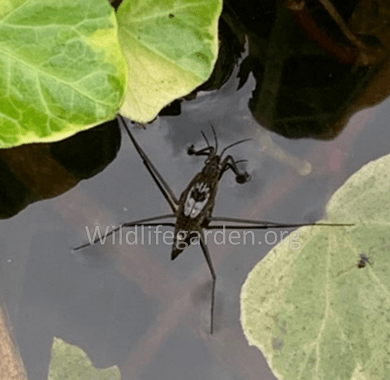
Obviously water surface tension is just a fact of life, one that many species like our friend the water skater takes full advantage of. Indeed, without this property of water, capillary action wouldnt be possible and vascular plants would not exist in the forms we are familiar with.

Fresh water habitats are a haven for many forms of life and conversley a hazard to many non-adapted species. The above drama is likely reinacted countless times every day in the Garden. We are posting about it purely as a topic of interest.

All we can really do as gardeners is to ensure our artificial freshwater habitats and containers don’t pose a risk to larger animals. We all know that ponds should have gently sloping sides anyway. Where this is not possible, for example, our fish pond, then an escape ramp is a must. Remember also that water butts should always have a secure lid.

DC – 28/12/2023

The Common Chrysalis Snail

Today we confirmed our first ever record of the normally very common land snail, Lauria cylindracea. Sadly we only found it’s shell, the animal itself obviously recently perished. It was attached to some Nostoc (a cyanobacterium) in amongst the mosses on the concrete steps as shown below.

Known as The Common Chrysalis Snail, we assume due to its shape, it can be confused with other similar species. So we placed the shell under higher magnification and gathered images of its identifying characteristics. Click on the link below to view our short species account of this snail;

https://wildlifegarden.org/common-chrysalis-snail/

Ask any gardener and they will tell you, usually in no uncertain terms, just how many snails can live in one small garden. However, it’s their diversity rather than abundance that we find so impressive. This species is our ninth species of snail so far recorded, we suspect the list will continue to grow.

Different snail species do have different food preferences, but most prefer already dead or decaying vegetable matter, although inevitably some tender shoots will be taken. They are important in the process of speeding up decomposition and recycling of nutrients. So we feel it is better to tolerate, perhaps even enjoy their presence, rather than attempt to kill as many as possible.

DC: 21/12/2023

Sparrowhawk

On the 12 December whilst sat at a bedroom window I spotted, out of the corner of my eye, what can only be described as a “Blur” near the garden fence. This was followed immediately by a puff of feathers and soon afterwards a cacophony of cries from circling carrion crows, magpies and gulls.

I initially thought a cat had taken a sparrow or a pigeon again. However our neighbour popped by a couple of minutes later saying a Sparrowhawk was sat in her garden devouring a pigeon. I nipped outside, poked my head over the fence and sure enough their she was, Mrs Sparrowhawk still tucking into her unfortunate victim. I was able to get some good footage of her as she continued to feast, despite her clearly knowing I was there.

Sparrowhawks are of course frequently seen in gardens, where thanks to their aerial agility they are able to navigate between obstacles almost effortlessly.

Another example of the wealth of wildlife that shares our homes and gardens and why the more effort and space we set aside for wildlife, the more we should be able to support amazing animals such as the Sparrowhawk, and of course its prey.

DC: 15/12/2023

The Return of 2 Favourites

We tend to focus on recording new species as we attempt to demonstrate the amazing diveristy of wildlife a single small urban garden can attract. But sometimes it’s nice to see species return, especially ones that we find particularly interesting or attractive. Two such species recorded in recent days fall into this latter category.

Firstly the Burnished Brass Moth. The video below doesn’t really do the species justice and we recommend having a look on google.

The larva of this species feed on some common and widespread plants, such as nettles, so you may come across them at some stage. The adults readily come to UV lighting.

Secondly a fungi! Now fungi are a bit of a challenge for us as identification of many species is extremely difficult. However not in this case, the stunning Green Elf Cup – Chlorociboriaceae aeruginascens. Last recorded fruiting on a branch we placed in the garden in November 2021. It never appeared on this branch again (but could well be dormant), yet showed up in recent days on a log in the boggy wetland area.

Green Elf Cup
21.09.2023

The fungi can actually stain the wood blue, and this was used by craftsman when creating decorative pieces, such as trinket boxes.

We do have a handful of new species to report, and will cover these in the September Diary update.

DC: 21/09/2023