On the 2nd of May, having taken advantage of the wonderful weather we’ve been having, we inspected the results of the previous night’s moth trap. We immediately noticed this amazing micro moth, which we have decided to call the Moo Moth.
We really shouldn’t just make up names, as it is bound to upset someone. This is really Ethmia quadrillella, and nationally speaking, it’s not all that common, as we found out while quickly checking our go-to guide on micro-moths (Sterling, P. & Parsons, M. (2012): Bloomsbury Wildlife Guides: Field Guide to the Micro-moths of Great Britain and Ireland. Bloomsbury Publishing Ltd). There seem to be a good many larval food plants listed for this species, many of which are common. The larvae feed from beneath a silken web.
It’s one of several species in the UK from this genus, but the only one we have ever recorded (as of the date below).
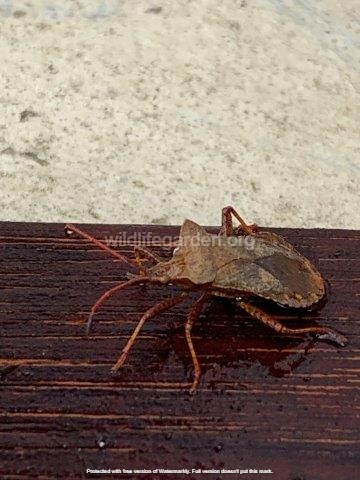
We do like the weird and wonderful-looking creatures that turn up in the Garden from time to time. On the 28th of April, we were visited for the first time in 2025 by Coreus marginatus, otherwise known as the Dock Bug. Nothing weird-sounding about that. But take a look at this little guy.
If you live in the south of England as we do, you’ve probably seen these guys before. They are common enough. They are a type of Shield Bug, perhaps not as common as the Green Shield Bugs we see frequently, but nonetheless an regular visitor.
It’s supposed to be a dead leaf mimic, which looks about right to us. As its name would suggest, it generally deposits its eggs on species in the Dock Family, but like the author of the book Shieldbugs suggests (see: Jones, Richard (2023). Shieldbugs. New Naturalist. HarperCollins Publishers, London), he more regularly sees them on bramble, which, as you can see, is where we found this little fella. Turns out they don’t mind the taste of those blackberries, although he will have to wait for some time yet as the brambles are still very much in flower.
Our first Garden record for this species was in July 2021 when we saved the guy pictured here from drowning in a bucket. We’ve had a soft spot for them ever since and it’s always nice to see the first one of the year.
We’ve had a few new species in the Garden during April, and the following two have very little in common, one being a True Bug and the other a Beetle. Apart, that is, from their vernacular name being Tortoise.
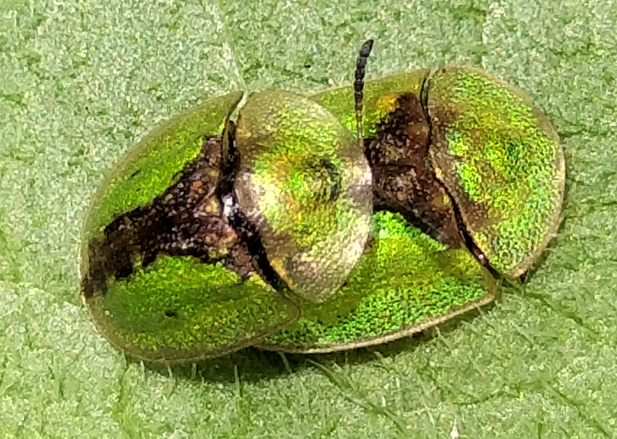
The Tortoise Beetle, recorded on the 20th April 2025.
These odd but very pretty looking beetles can be easily overlooked. They are well camouflaged and have a sort of glistening/metallic green/yellow appearance. This mating pair was recorded on one of their many food plants, Black Knapweed.
Their Latin name is Cassida vibex, and there are only a few native species from the genus Cassida recorded in Great Britain. This species is generally easy enough to identify due to that dark band running down the elytra, and when present, note the black spots on either side of the elytra.
Most of the ‘bits’ you cannot see are where you would otherwise expect them to be. The beetle, of course, has eyes and antennae, but these are all safely tucked up underneath for protection. When not mating, an individual, if threatened, can completely flatten itself against the leaf surface, forming a tight seal.
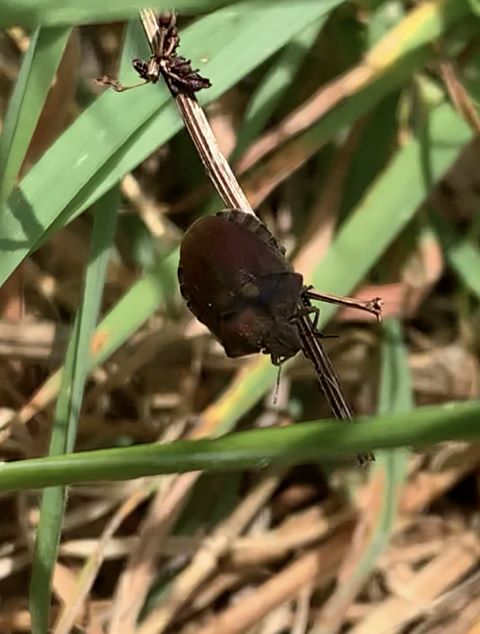
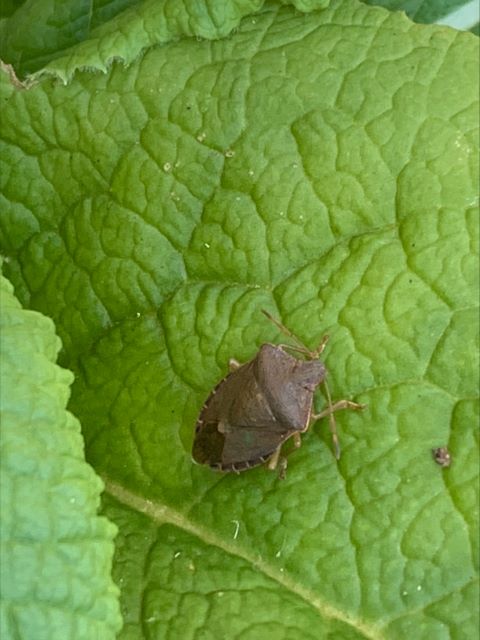
Our second Tortoise, recorded a few days later on the 28th April 2025, was the Tortoise Bug. Not a beetle this time, but a species of true bug belonging to the order Hemiptera. This shield bug (what Americans call stink bugs) initially confused us, as we thought it was a Sloe Bug, but it had something ‘different’ about it.
It’s latin name is Eurygaster testudinaria, and according to some online sites it is doing rather well and becoming more common, especially in the south of England where we are.
We had to trap the little guy before we were able to determine the species. If you look at the video below, you will notice, at around 18 seconds, that the antennae are black for the final two segments, a feature of this species. There is really only one other species it can be mistaken for, but this is rather rare and lacks the central indentation you can see in the center of our specimen’s head.
The bug was quickly returned to the Garden where we found it.
So, two new species for the garden. We have a couple more that we will add to the website when we find a bit of time.
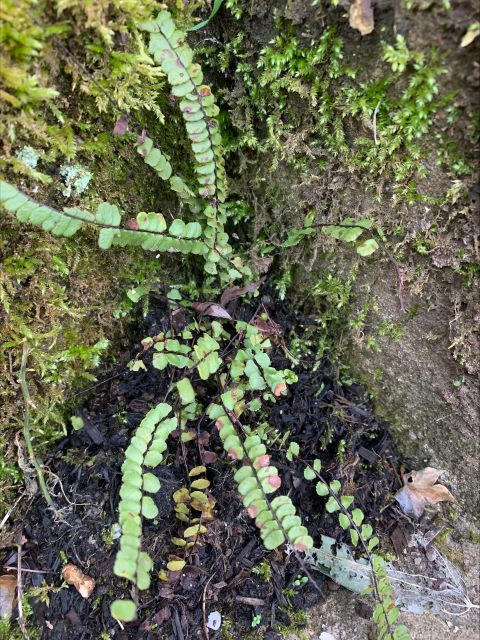
Introducing Maidenhair Spleenwort, Asplenium trichomanes, the first new species added to our Garden list in 2025. We actually found this fern last Autumn, detached from a wooded bank in a nearby car park and decided to bring it home. We gave it a spot on the concrete steps, where it’s close relative, Hart’s Tongue Fern, has freely colonised from a single introduced individual many years ago.
Typically we don’t add a plant species to the species list until it has survived and flowered at least once. As ferns don’t flower, we decided to add it only if it survived the winter. Which we are glad to say it has.
This species is common in many parts of the world and is perhaps one of the most attractive ferns about, and as such a garden favourite. Although at present, all the Garden ferns are currently looking a little shabby after the long winter.
Maidenhair Spleenwort 3rd March 2025
We’ve also started to see a few of our resident species about. Spotted Wolf Spiders (our most abundant spider in the Garden) are already dashing about in the leaf litter. Plus:
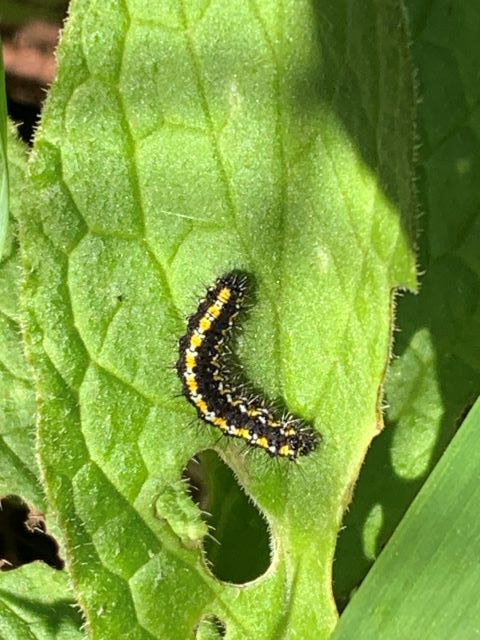
We also recorded our first Scarlet Tiger Moth, well it’s larva (caterpillar), chomping on some Green Alkenet, in the first bright sunshine of Spring (2nd March 2025).
We also spotted our first Green Shieldbug of the year on the 2nd March. Note, that in winter they turn bronze in colour before they hibernate. This fella has not long become active again.
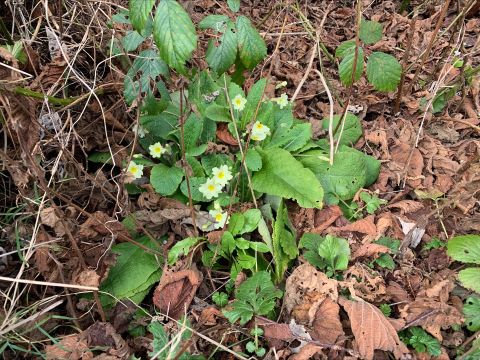
And finally we found our small patch of Primroses had survived beneath the bramble and hazel. Spotted flowering on the 1st March 2025.
So, spring has arrived and our resident species are waking up.
Another very wet winter is almost at an end and as mentioned in previous updates, we tend to stay off the Garden during winter to avoid compacting the soil. In fact it’s been such a misserable winter we haven’t done much in the Garden at all. Thankfully spring is almost here, although the weather remains grey and wet for now.
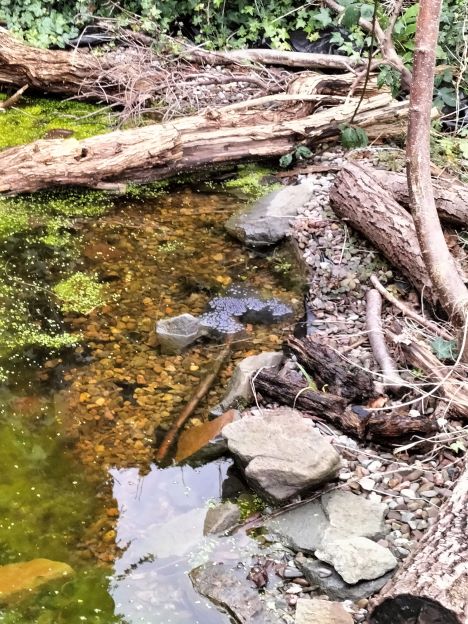
But we have seen the earlier signs of spring. Small flocks of Gold Finch have been passing through the Garden in the last couple of weeks, the Hazel tree is full of catkins and finally last night, 22nd February, we heard the return of our favourites, the Frogs. Although, we already knew they were back and busy a week before, when we noted the first frog spawn of the year in the larger pond on the 16th February.
Centre Image: First Frog Spawn 16th Feb 2025
We began 2024 with 582 recorded species in the Garden and ended it with 623, our lowest every uplift in new species recorded in the Garden (just 41 for the whole year). Of these 623 species, 218 have not been recorded in the last 5 years. Whilst this seems alarming, especially after the unprecidented poor year for wildlife in 2024, the majority of these 218 species are moths and we simply have not been trapping enough to record many of these species. Indeed only 13 species were not moths and we will focus on these during 2025 to see if we can find them, they are:
Two insects Malthodes spp (an unidentified Soilder Beetle), Neoascia podagrica (a Hoverfly)
Four species of mammals – Common Noctule Bat, Common Pipistrelle, Hedgehog, Brown Rat
One amphibian – Common Toad
One reptile – Grass Snake
Three birds – Great Tit, Coal Tit, Song Thrush
Two plants – Forget-me-not and Rough Meadow Grass
Of these we are reasonably sure Forget-me-nots are no longer present in the Garden. Rough Meadow Grass is, we just havent recorded it. Great Tits will almost certainly be present from time to time, whereas we havent seen Coal Tit or Song Thrush for a long while.
Grass Snakes are unlikely to return but are recorded regularly in the nearby nature reserve. Currently its difficult for hedgehogs to enter the Garden, although a nearby neighbour recorded three at once in her Garden not so long ago. We have definately seen Brown Rats, just not recorded them, likewise we have picked up both species of bat listed above with our basic bat detector. Although despite scanning for them several times last year, we didnt detect or spot a single bat. Yet the real concern for us remains the Common Toad, we just don’t know why we are not seeing these, especially as we regularly record Common Frogs and Palmate Newts.
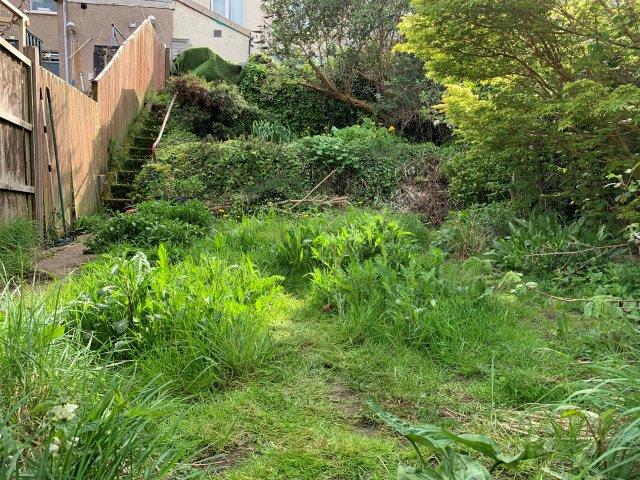
In 2006 we planted Ivy next to the top of the large retaining wall in our Garden, and during this time it has spread to the smaller retaining wall below this, as shown in the centre of the image below taken in April 2023. Indeed, if left unchecked, it would have probably spread across most of the Garden during this time. It constantly needs cutting back.
It’s a plant we take for granted really, yet with the possible exception of the hazel tree, it’s probably the largest plant in the garden. It hides those ugly concrete block retaining walls and offers shelter for invertebrates, small mammals, birds, and amphibians.
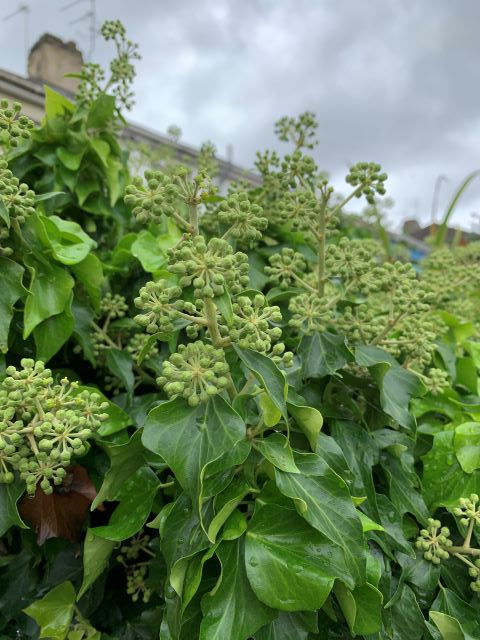
However, the one thing it has never done in all this time is flower. Until this year that is, when on the 24th of September 2024 we noted a small section of the ivy near the top of the garden steps looking like this.
I’ve mentioned this to a couple of people since, and they were a little surprised to discover ivy ever flowered. Perhaps this is because it is an evergreen or that the flowers are a little unusual. Maybe it’s simply that people mostly find ivy in woodlands and fail to either notice the flowers at all or don’t associate the flowers with the ivy plant itself.
Whatever the reason, we have been waiting a very long time for this to happen; we’d almost given up hope to be honest. Flowering ivy offers a very late source of nectar to many invertebrates and is especially important for those that will overwinter as adults to complete their life cycles the following year. We often note plume moths and crane flies sheltering within the foliage, although in the former case this may be due to bindweed (the larval food plant of common plume moths) growing amongst the ivy for support. In the wild, ivy is useful for a great many species, including roosting habitat for bats.
Ivy is slightly unusual in that it exists in two forms. A juvenile form, where it grows and clings to surfaces using specialized hair-like structures, and a mature form which can support itself, but more importantly produces flowers. The juvenile stage can typically last 10 years, but in our case it has taken 18, and even now it is only flowering over a relatively small section.
The fruits should develop between November and January, and can be a useful food source for foraging birds during the winter months. We will keep an eye out for the fruits and hopefully next year more of the plant will be able to produce flowers.
Wildlife never ceases to surprise us, and it turns out our resident newts are no exception. Of all the things you could say about a newt, being speedy on land was not something we would have expected. But look at this tiny palmate newt go, we struggled to keep the camera on it.
We only filmed for 60 seconds, then stepped back and watched it safely to the garden shrub border. We found it wandering at the far end of the garden, a few meters from the boggy area. This is typical behavior, as once the larvae have absorbed their gills, they can leave the water, usually around August time.
This little fella will now feed on invertebrates before finding shelter for the winter, such as under stones, the compost heap, or other sheltered refuge. Another reason why disturbance is best kept to a minimum during winter (or any season really).
Well, after almost exactly a year, we have finally completed our wildlife pond. Not that we won’t continue to add to it, but for now, we will let nature take its course and see how it matures.
We have added a full account of what we did and some of the challenges/delays we faced on our Projects Page, the link to this project can be found HERE.
We genuinely couldn’t be happier with how this has turned out, and it has attracted so much more wildlife already, including many species new to the Garden. One of the most impressive and not really discussed in the project page link above is the Southern Hawker. You can see two females in the clip below laying eggs on some deadwood in the pond. It’s brilliant to sit next to the pond and allow these fearless insects to dart around your head, foraging for prey on the wing.
Next up on our to do list may well be connecting the pond to the wetland area we created in 2022 on the bottom level of the Garden, which has become choked with aggressive grass species (mostly yorkshire fog) to ensure this to receives enough fresh water.
It has to be said, this year so far has been very poor for invertebrates. Frequent walks in the Garden on sunny days are simply not finding very much at all. The image below was taken on the 29th of June, in perfect conditions: gentle breeze, warm, and bright. Yet very little was on the wing. We’ve noted in previous years that some species or families of species have good and bad years. For instance, 2022 was particularly poor for ladybirds. But this year just seems to be poor for everything. This is, of course, concerning as invertebrates form a vital resource in the food chain, and many birds and mammals, especially chicks dependent on invertebrate prey, may well be suffering as a result.
Garden image 29th June 2024
That said, we have identified a couple of new Garden insect species recently.
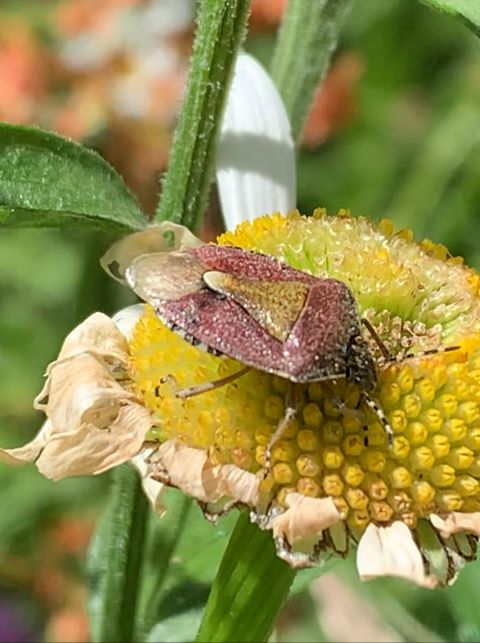
First up is a third species of shield bug belonging to the family Pentatomidae, the Sloe Bug or Dolycoris baccarum. It’s a species we see all the time in the surrounding area but have never once seen in the Garden itself.
Contrary to its name, it feeds on the flowers of many different plants, not just Blackthorn, and is a common species. It’s also known as the Hairy Shield bug. That grey fuzziness you can see in this image is indeed a fine mottling of hairs. And just look at those colours, fantastic.
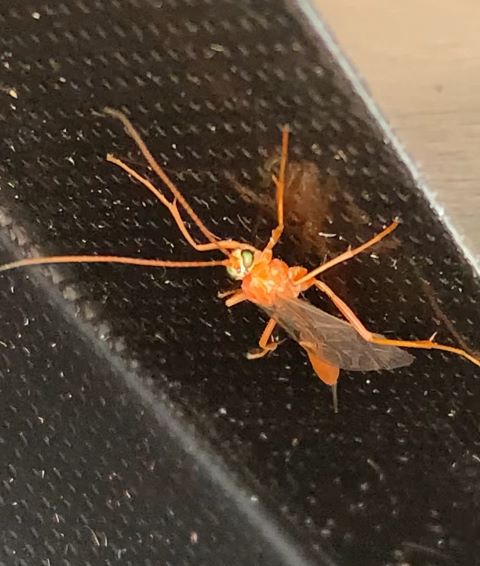
The second new species arrived at the moth trap, but it’s not a moth. Take a look at this fella.
It’s a nocturnal ichneumon wasp, but we cannot be certain of the exact species. We suspect it belongs to the genus Ophion, which is mostly an endoparasite feeding on the larvae of moths.
All very concerning. We know other people and specialists are also reporting poor numbers of invertebrates, and we suspect there will be various explanations given for why this may be. All we can do with our green spaces is provide as much resource as possible for as many key stages of an invertebrate’s development as possible. Food (and water), shelter, and a lack of disturbance throughout the year are vital.
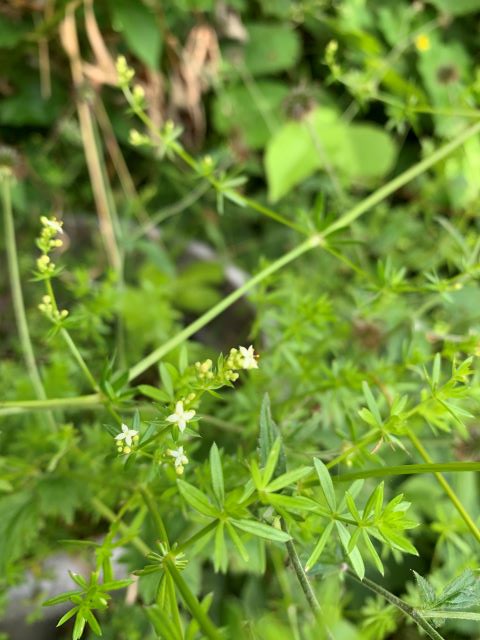
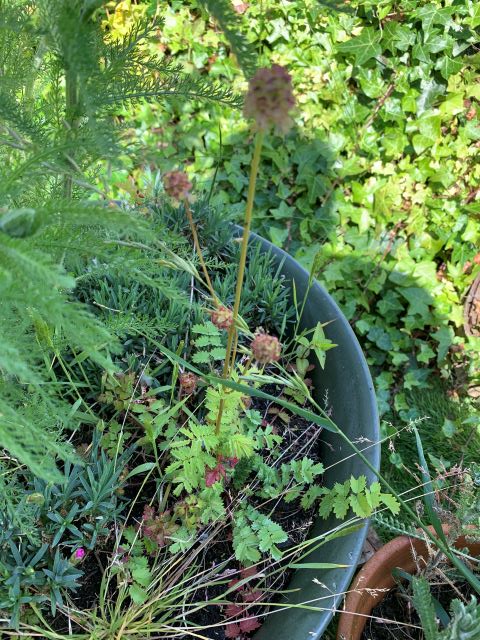
We have this funny rule in the Garden, that a wildflower cannot be added to our Garden species list unless it has flowered at least once somewhere in the Garden. Last summer we noted two wildflowers for the first time, one being Hedge Bedstraw – Galium album, the other Salad Burnet – Sanguisorba minor.
Hedge Bedstraw: Now, if you think this looks familiar, you would be right. This species is closely related to Cleavers, or as most of us know it Sticky Weed, which is also present in the garden. Both belong to the genus Galium. We like having Galium species around as their tiny flowers contrast nicely with the massive oxeye daisies which now dominate the meadow area. We currently have this species flowering in both pots and within the meadow, competing well with the surrounding knapweeds and oxeyes.
Salad Burnet: This is an edible species which according to Wikipedia is found only on Limestone Grassland Sites. This is certainly where we see it normally when we visit places like the Mendip Hills. But in this image it is growing in a pot of peat free compost from Tesco’s, so we suspect it is not completely limited by soil type. More interestingly it can apparently live for 20 years. We only have this one plant growing in the Garden. Hopefully we can collect some seed and spread it around a little.
To complete the story, neither species flowered in 2023, as is the case with many perennials during their first year. So it was simply a case of waiting to see if they would survive the winter and bloom in 2024. Winter here was very wet, but also very mild, and both species survived. The Bedstraw positively flourished. And finally this month, both flowered: Salad Burnet on the 11th of June and Hedge Bedstraw a little later on the 21st of June. So two more species on the Garden list, both very welcome in the Garden.


 Wildlife Garden