Dolycoris baccarum
Date First/Last Recorded in the Garden: 29.06.2024
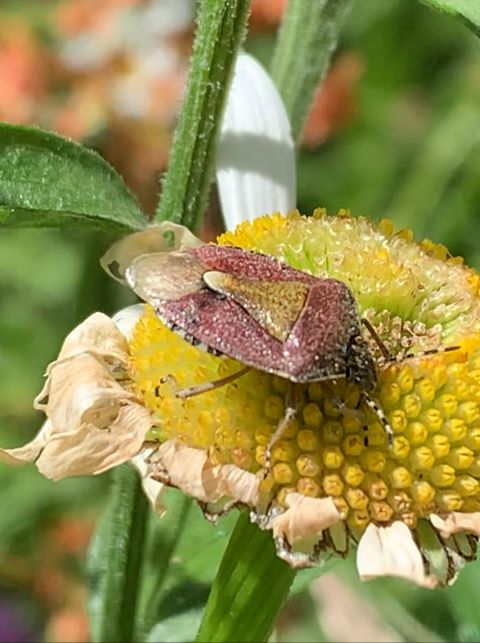
Family Pentatomidae: Shield Bugs
A good sized family, with around 4700 species recorded world wide. They are mostly phytophagus (plant feeders), sporting piercing sucking mouth parts. These are the insects that Americans often refer to as Stink Bugs due to their containing certain compounds which smell strongly when they release them to put off predators. They also, according to online sources, contain cyanide compounds to deter predators.
Sloe (or Hairy) Shield Bug – Dolycoris baccarum
The colouration is distinct in the summer, purple and olive-green as shown above, with clearly defined black and white margins and antennae. The olive-green triangle is known as the scutellum, and note in this species it usually ends in a much paler colour. In summer, and shortly after death, these colours fade and like many shield bug species they become more brown. Like all shield bugs they go through several stages of nymph development known as instars. The video clip below is an early instar of this species we found on a dry grass seed head.
Some online sites often suggest this species does not feed upon sloes or any part of the Blackthorn plant. Whilst other sites suggest the opposite. The New Naturalist 2023 book, simply titled Shieldbugs*, by Richard Jones (excellent by the way), Jones, Richard (2023). Shieldbugs. New Naturalist. HarperCollins Publishers, London, offers this explanation (paraphrased).
During a long survey of Shieldbugs in Surrey, not one example was found of this species feeding on Blackthorn. However, the surveyor concluded that despite this, the common name Sloe Shieldbug was well established in places like Kent, and as the surveyor spent relatively little time surveying Blackthorn compared to the fruit producers of Kent, perhaps they knew best on the matter.
Either way, this bug is just as often known by its other common name, the Hairy Shieldbug, which is apt considering both the adults and nymphs sport a fine covering of hair.
In the Garden
Both the nymphs and the adults will find food in the Garden. The New Naturalist book noted above confirms many plants found in the Garden are known food plants, including plantains, knapweeds, nettles and dead nettles. Indeed, the list is much longer, and most gardens could support something these guys like to eat.
They overwinter in the adult form, emerge in spring to reproduce, causing an initial peak around May. The nymphs produced then grow, resulting in a further peak around September. This generation then overwinters again to kickstart the cycle the following year. So look for the adults of this species at these key times.
As with so many other species recorded on this website, many may well want to spend the winter in our gardens, and it is vital that as little disturbance occurs as possible, beyond that needed to maintain the habitats present.
References
- Jones, Richard (2023). Shieldbugs. New Naturalist. HarperCollins Publishers, London,
 Wildlife Garden