(previously Triturus helveticus)
Family Salamandridae
Newts belong to the family Salamandridae. Newts are effectively salamanders that have to return to water to breed and have an aquatic larval stage. All 12 European species were once considered to be in the genus Triturus, which was subdivided into 7 large-bodied species and 5 small-bodied species (*1).
In the UK, there are three native species of newt. The Common or Smooth Newt (Triturus vulgaris), which, along with the Palmate Newt is a small-bodied newt, and the Great Crested Newt (Triturus cristatus), our only large-bodied species. However, in 2004, the two subgroups were considered worthy of their own individual families. The large-bodied newts were retained in the genus Triturus, so our Great Crested Newt remained Triturus cristatus, while the small-bodied newts were renamed under the genus Lissotriton.
All British species of newt lay their eggs singly wrapped in a leaf, unlike our other amphibians (Frogs and Toads) which produce eggs en masse as free-floating frog/toad spawn. Upon hatching, newt larvae are much more developed than frogs or toads and never appear tadpole-like, quickly resembling the adult.
Palmate Newt – Lissotriton helveticus
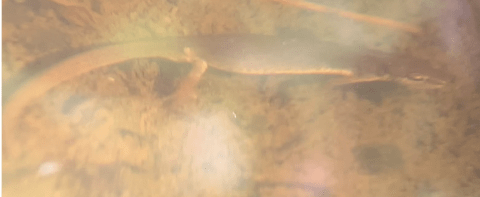
This is the UK’s smallest native amphibian species. They arrived within weeks of the pond we created in 2023 being filled with water. However, it took us nearly a year to identify one due to our having to fill the pond with nutrient-rich tap water, which made the water turbid. Slowly, we have replaced this water with low-nutrient rainwater, and by summer 2024, the water was crystal clear, and we were able to film the male Palmate newt below.
They feed on a variety of zooplankton/invertebrates that inhabit the pond. According to the new naturalist book below (1*, a book well worth reading), they prefer well-vegetated ponds. However, at the time of identifying the individual above, our pond was lacking vegetation as we wanted to see which species colonize naturally. However, we are currently rethinking this idea as newts need plants on which to attach their eggs, and we want to encourage these amazing creatures to stay.
That said, the video below taken earlier in the year in the same pond (2nd June 2024), we believe is a newt larva (species unknown but assuming Palmate also). Suggesting newts can breed in the absence of vegetation.
1* Beebee, T. Griffiths, R. (2000) Amphibians & Reptiles. New Naturalist. HarperCollins Publishers, London.
 Wildlife Garden