The Pond
By summer 2023 we already suspected that the small wildlife pond on the middle level of the Garden was not very healthy. A bit of pond dipping quickly suggested that very little life was present in the pond, the odd Water Slater (Asellus aquaticus) and plenty of Physa sp (freshwater snails), but little else.

August 2023: The original small wildlife pond on the middle level of the garden was completely covered in a thick layer of duckweed and contained as much sludge as it did water.
We quickly decided that the pond was;
a) Uneccesarily small, there was plenty more space available.
b) Poorly located beneath a large buddleia bush, shedding leaves into the water every year.
c) Was effectively devoid of wildlife due to poor water quality.
With the pond in such a poor state we saw no obvious reason not to begin replacing it immediately.
28th August 2023: The original pond was emptied of water and all the sludge was removed and buried in a deep pit at the end of the Garden. Almost no animal wildlife was found during this process.
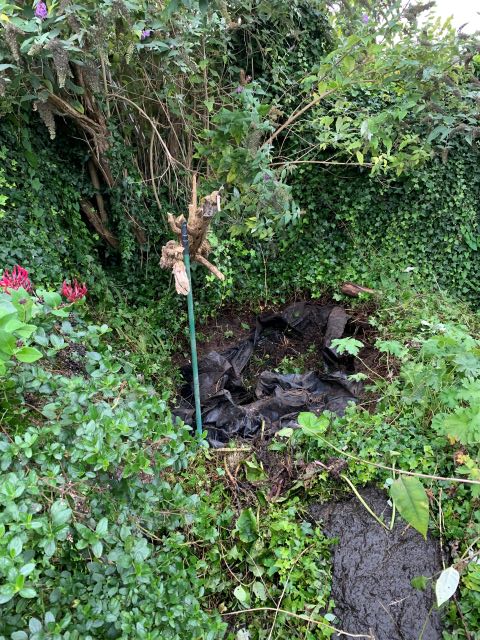
The next and perhaps most difficult task was to remove the buddleia, which had self seeded some 20 years prior and was of significant size. We had mixed emotions about removing this bush. On the one hand buddleia is a non-native and highliy invasive plant. In the local area it can be found just about everywhere, including growing from peoples chimneys. Yet, it was also very popular with butterflies, bees and hoverflies. On balance however, and to help the longevity of the new pond and its overall health, it simply had to go.
The weather wasn’t always our friend, so it was removed over several days. By the end of September 2023 we removed the remainder of root system.
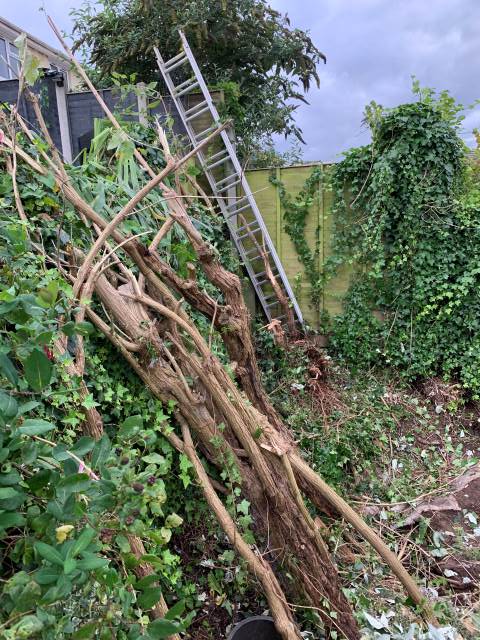
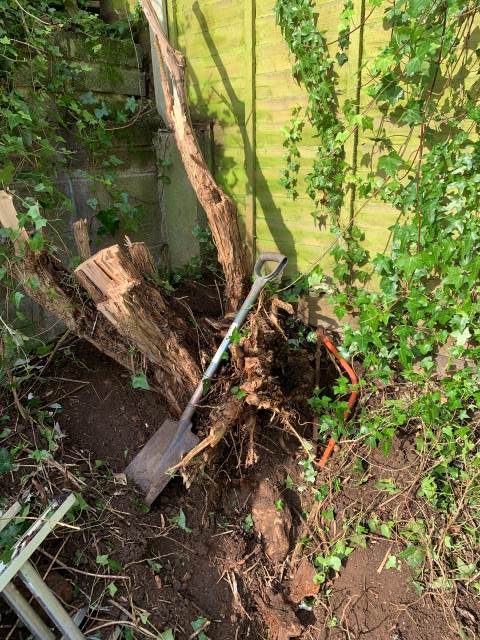

The next stage was to remove all the other vegetation, including the California Lilac, another favourite of the nectar loving invertebrates, especially the rose chafers. However, it was already dying off for some unknown reason and was preventing us accessing the full areas as was required.
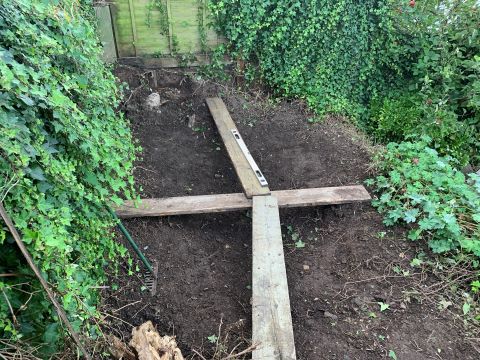
With the hard work done, we began moving soil into the shape and depth we wanted for the final pond. Deep water is of little use to our native wildlife and really a pond need be no deeper than 30-40cm at its greatest depth, gradually sloping up to the edge to form a shallow bowl, with some ledges cut into the slope to hold any gravel substrate we may decided to add later. By the 7th October we had the shape we wanted worked out and the levels correct to prevent any unplanned overflow areas along the edges.
Thankfully pond liner is relatively inexpensive these days and often comes with some low quality protective sheeting to help reduce the risk of punctures. It still makes sense to remove any stones and roots that might poke through the liner.
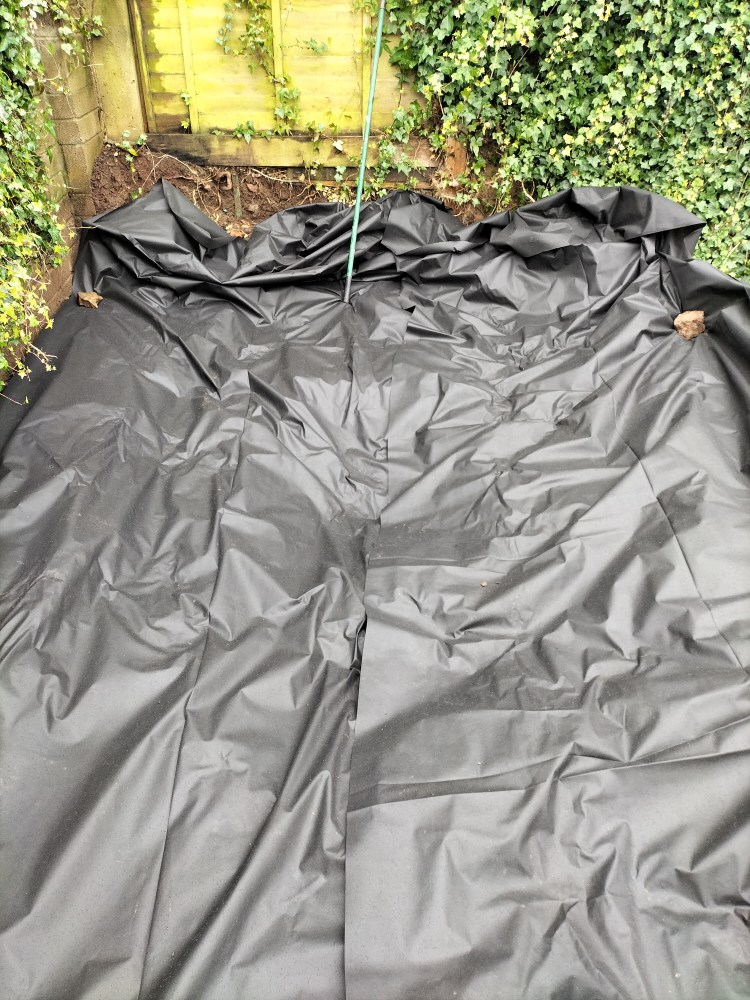
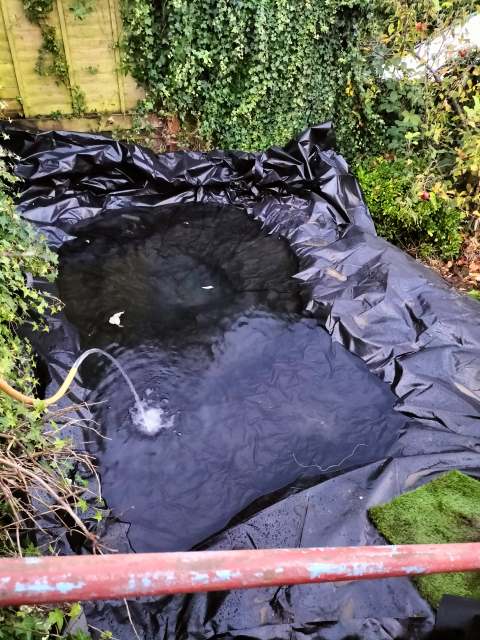
Due to a processing error it took a few weeks for our liner to arrive, but as we had started early and the hard work was done, this wasnt an issue. On the 27th & 28th November the pond was lined and filled with tap water. Once filled you can see the ledges we created in the right hand image below.
The Water
You may read online that you should avoid using tap water when filling a wildlife pond, especially one that will not have any UV filtration to kill excess algae. This is very good advice. Tap water contains 10 x the levels of nitrates you would typically find in a fresh rain water filled pool (on average). In natural situations, nutrient levels would be very low and this is the basis of a healthy pond. High nutient levels allow algae to grow almost unchecked, leading to poor turbidity and lower oxygen levels.
So why did we use tap water? The winter of 2023 was the wettest on record in Bristol, easily enough rain fell to fill the pond a several times over. The reason was rather unexpected. It seems the local cat population liked nothing more than to do their “business” on the liner and then to add insult to injury, to claw at the liner in a useless attempt to bury the evidence. The only way we could think to protect the liner was to fill the whole thing with water and quickly.
Our solution to the issue of nutrient levels was simple enough. We created a channel at one end of the pond that would, with the unfolding of a section of the pond liner edge, allow a couple of inches of water to drain everytime rain filled the pond above a certain level. Thankfully, it rained so much over the winter that by the time spring arrived we had been able to drain away a couple of inches of water every two or three weeks. The short clip below was filmed on the 27th April 2024 and was the last time we did this prior to summer 2024. Note the net, this was to catch any tadpoles that may have somehow managed to wriggle through the gravel. As it turned out none did.
The water in the pond has gradually cleared throughout this period of draining, and we believe the nutients from the original tap water have become considerably less concentrated with the resulting decline in aglal growth in the water.
The Character
With the hard work done, we set about adding gravel, pebbles, rocks and deadwood to the pond as features of interest, creating lots of niches for whatever could use them and creating the character of a naturally forming pond. At the time of writing this (June 2024) we are still very much in the process of doing this but by May 2024 the pond looked like this…

Note the random scattering of sticks along the gravel edges, this is once again to try and deter cats from messing where they shouldn’t.
When the water is at its highest, it can penetrate the gravel edges but any higher and it will drain out in the same location as the channel shown above. Gathering resources to add to the pond will be something we now do over time. Wildlife has already begun to move in and we don’t want to cause more disturbance than is necessary.
The Wildlife
Wildlife began using the pond almost as soon as it was full. A few days after filling the pond, whilst folding back some of the excess liner, we discovered three Common Frogs hiding under the liner. A week later our first newt was found. Oddly, and worryingly and as mentioned elsewhere on this site, we have not recorded any Common Toads since before we began this project in 2021.
We are also still unsure which species of newt we have. All our sightings of adults are fleeting and we have never seen more than one at any time. However on the 2nd June 2024 we finally got some photographic evidence, see the clip below, of a newt larva enjoying the warmer shallows at the ponds edge.
And it’s not just been amphibians attracted to the new pond. We’ve seen numerous Helophilus pendulous (Sunfly / Footballer Hoverflies) hanging around the pond. The larva of this species, the so called rat-tailed maggots, are aquatic and will thrive in just about any body of water they are deposited in.
Incidently, the Greek term Helophilus translates to ‘helo’ = marsh, ‘phil’ = love. So we were not entirely surprised when attempting to identify the following beetle to discover it most likely belongs to a genus called Helophorus.
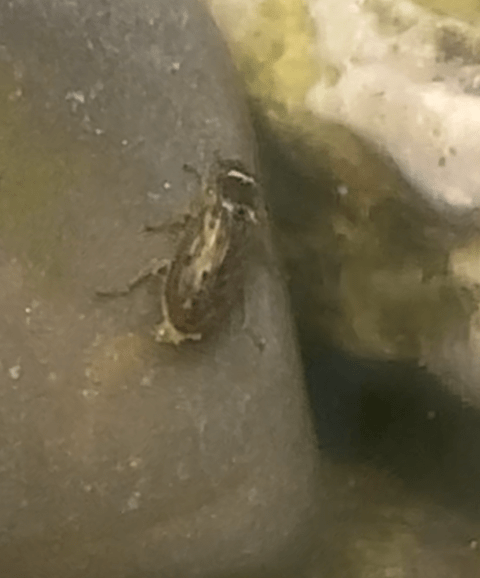
This Helophorus species of beetle (pictured below), which are otherwise known as Water Scavenger Beetles, was recorded in the pond on the 2nd June 2024. We are a little unsure about our identification of this species, it may well belong to the genus Laccobius.
These guys are very capable flyers but to date we have only seen them within the pond water itself. The adults are vegetarian, most likely feeding on algae/moss/detritus. It seems that most, if not all, British species can be found in a variety of standing or slow-moving freshwater habitats.
According to several sources, the eggs are laid within a silk cocoon amongst damp margin substrates during the autumn. Only hatching the following spring, when the larva then begin to feed on small invertebrates within these marginal habitats.
We also blogged earlier in 2024 about the emergance of numerous Large Red Damselflies from the boggy area of the Garden (see blog entry 14th May 2024). Since this time we have seen many adults at the new pond laying eggs. There is still a total lack of emergent vegetation in the pond to act as cover, so it was relatively easy to film the females, accompanied as always by the male, laying her eggs directly into the water.
Other species of insect, like the non-biting midges below, were even quicker off the mark. Due to the pond still being in it’s early stages of development, it is perhaps lacking the numbers of predators that it should have once it has matured. As such there were periods when midge larvae numbers were exceptionally high.
From each surviving larva a midge emerges, like the one below (species unknown). Along with hundreds of others, forming the familiar dancing clouds near the waters edge.
Other common insects were also quick to arrive, including whirligig beetles (species unknown) and pond skaters. Even the Wolf Spiders, so dominant in the adjacent meadow area, were quick to take advantage, and are seen in good numbers patrolling the gravel edges of the pond.
In terms of plants, we have noted that Duckweed has inevitably arrived, but doesnt seem to be spreading very much at all. A good indicator that we have healthy (low) levels of nutrients. Sadly, in the wider countryside, nutrients from a variety of sources (pollution, agriculture, waste water discharge) are devestating our fresh water ecosystems, causing algal blooms, eutrophication and oxygen depletion. Resulting in less biodiversity and poorly functioning fresh water ecosystems.
All the more reason to create wildlife ponds in Gardens and to allow them to fill up with rainwater. You can always collect rain water in butts to replenish water during the summer. Or, as does naturally occur, allow the pond to dry out occasionally. Although very small ponds may be prone to drying out each year, in which case keeping some water in the pond throughout most years would be advisable.
DC: 14.06.2024
 Wildlife Garden