Eupeodes corollae
Date First Recorded in the Garden: 05.06.2021
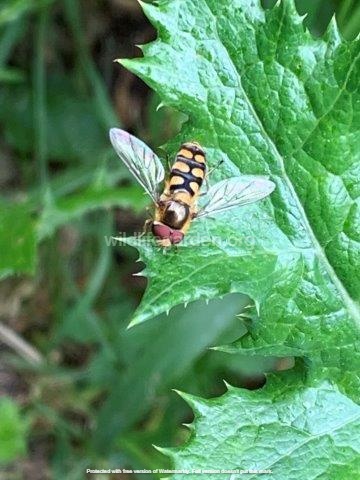
Family Syrphidae: Hoverflies
A very familiar and attractive family of flies belonging to the insect order Diptera (or True Flies). They have a single pair of wings, unlike most insect orders that have two pairs. Many species of hoverflies sport a yellow/black colour combination and are therefore often mistaken for bees or wasps, which many hoverflies attempt to mimic. However, they lack the ability to sting and are totally harmless.
With over 280 species recorded in the British Isles, most gardens will at some point in the year play host to more than one species. Many species are considered beneficial as their larvae feed throughout their development on aphids.
Interestingly, in most hoverfly species sex can be determined simply by looking at the hoverflies eyes. Usually if the eyes meet at the top of the head, then it’s a male; if separated then it’s a female. There area few species where this doesn’t hold true because they have males with eyes that are separated, however if they do meet you can be sure its a male.
Migrant Hoverfly – Eupeodes corollae
As the name suggests, this is a migratory species and one we see in the Garden often. On the 21st May 2023 we happened across a breeding pair, which allowed up to see the differences between the two sexes of this sexually dimorphic species.
But first we had to confirm this was indeed Eupeodes Corollae. According to ref 1 below, of all the yellow and black marked hoverflies, only in Eupeodes do we see the yellow hairs on tergite 2 (T2), to be replaced by short black ones from tergite 3 (T3) onwards, as shown below.
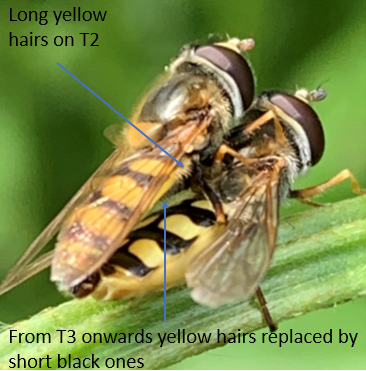
There are 9 species of Eupeodes recorded in Great Britain, but only 3 are likely to be seen in a garden, E. luniger, E. corollae and E. latifasciatus. The first clue that this is E.corollae is found by looking at the females face.
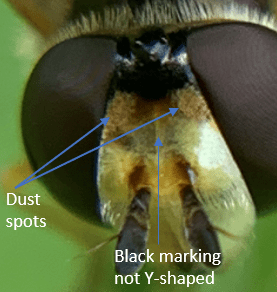
The Field Guide (1) has several images that compare the different species, but as we have none to compare the above too, you’ll have to take our word for it that because the dark area of the face above the antenna, know as the frons, is not Y-shaped or has a lower straight edge, then this is likely E. corollae. The dust spots (which are actually flattened hairs) as highlighted above also support this conclusion.
We can look at the abdominal markings for identifying characteristics. In male E. corollae, the yellow markings at the edge of the abdomen make up more than 50% of this margin. And it is only in E. corollae that the yellow markings reach the margin at all in females.
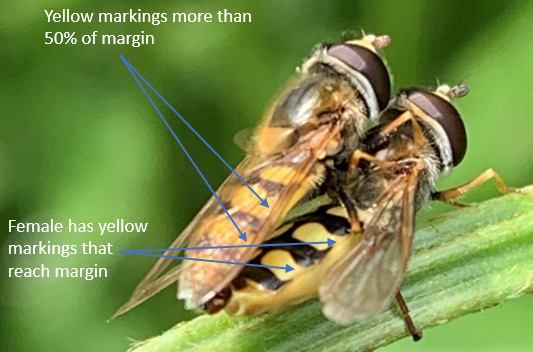
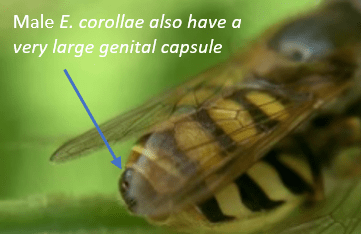
Finally, male E. corollae also have a very large genital capsule as can clearly be seen in the individual below. So all in all we are confident we have this species accurately recorded.
 Wildlife Garden