

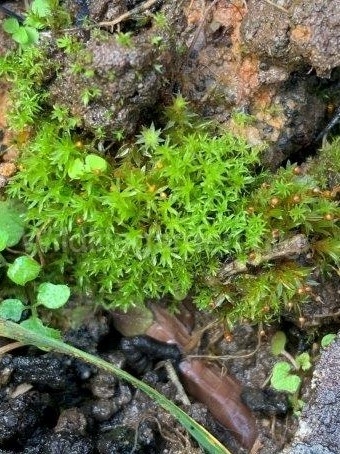
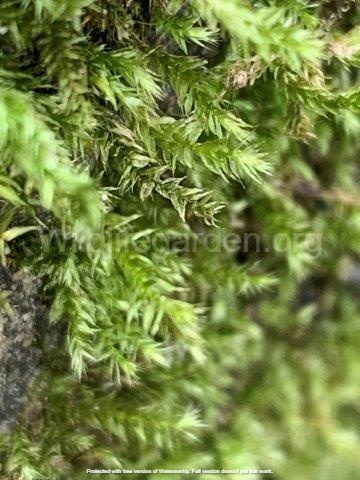
If you wish to give your garden a true wild/ancient/natural feel, then allowing mosses to develop and grow wherever they set up home might be the answer. In any case there is no need to discourage them, they are after all just little plants.

Mosses actually complete their life cycle in two very distinct stages or generations. The green plant like structure you can see in the above image is known as the Haploid Generation. Haploid meaning it only has half the full set of chromosomes, in much the same way as a mammals egg or sperm only has half the genetic material.
Individual mosses may have either male or female reproductive parts or both. In any case once they reproduce, this results in a Diploid generation growing, which has a full set of chromosomes. So to continue the mammalian analogy, this is like the adult animal itself.
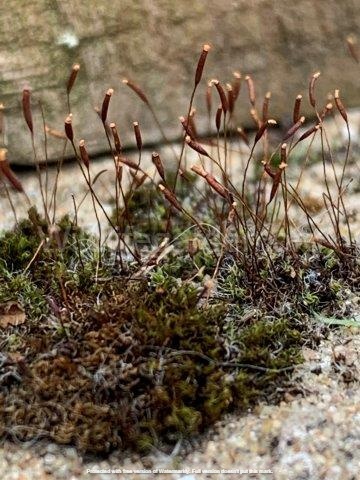
Both generations can be easily seen in the photograph of Wall Screw Moss below. The Haploid Plant/Generation, with only half the full set of chromosomes is the fuzzy stuff growing on the stone. Whilst the Diploid Plant/Generation is the stem and capsule structure you see growing from it.
Inside its capsule the Diploid Plant produces spores with half the number of chromosomes. These Haploid spores once released can start the whole process again by growing into the Haploid generation.
There are just over 1000 different species of bryophyte in the UK. As it happens our climate is perfect for mosses and liverworts and we have around 60% of all the species found across the whole of Europe*.

- *Porley, R. Hodgetts, N. (2005) Mosses & Liverworts. New Naturalist . HarperCollins Publishers, London.
- **British Bryological Society: Mosses and Liverworts of Britain and Ireland a field guide. Latimer Trend & Co, Ltd. Plymouth. 2010
 Wildlife Garden