I think it’s fair to say that when Bristol (UK) woke up on the 2nd March 2024, the last thing anyone expected to see and certainly the one thing the weatherman forgot to mention was this…
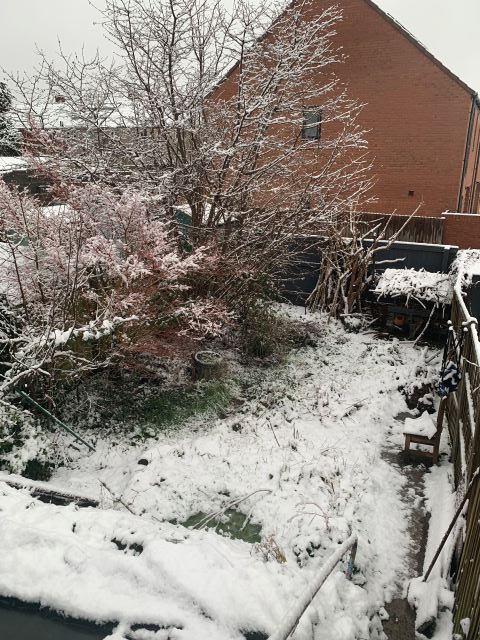
…Then, for the remainder of the month, considerable amounts of rain fell on most days. There were a few breaks however, when the sun came out and enticed some work in the Garden. Both newts and frogs seemed well at home in what remains a very sparse new pond on the middle level of the Garden, but the pond is coming along nicely.
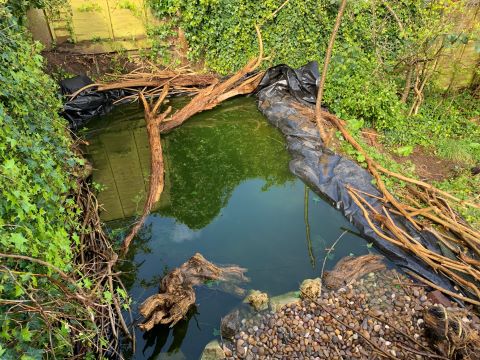
We are hoping for plants to establish themselves, and it seems somehow some of last years Yellow Iris seed has made its way into the pond already. The marsh marigold we removed from the old smaller pond and placed on the compost heap, seems to have survived happily in its new location. We may transfer some over to the new pond later in the year.
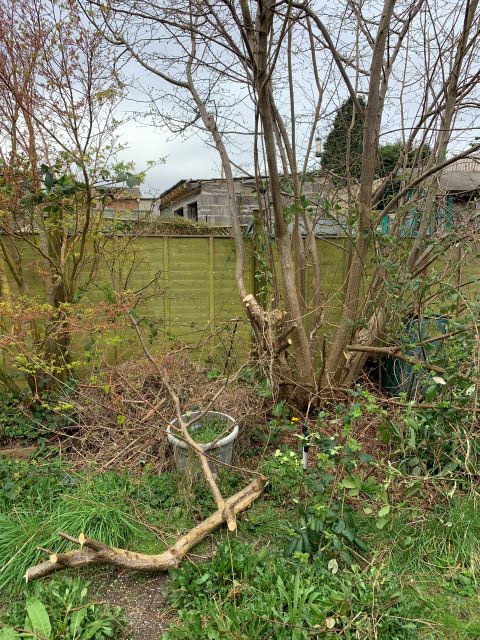
The pond project was one of two things we wanted to get done this winter. The other being coppicing the Hazel. However, in order to create the new pond, both the buddleia and Californian lilac had to be removed. These were two of the larger shrubs in the Garden. To lose the Hazel for a few years would seem a step too far. So instead we gave Harry Hazel a hair cut and took off some of the larger branches which were overhanging the rest of the Garden/Meadow area.
Since trimming the hazel, we are glad to see the rest has started to come into leaf. We will wait for the canopy to open and then see if we still need to knock off a few branches here and there. All the larger material was then incorporated into the pond edge habitat.
The Garden is developing nicely and when we were able to get out we found lots of species starting to emerge including a number of new Garden records. These were covered in our blog, but to recap they including Case-bearing Clothes Moth, Common Field Speedwell, Limoniidae sp (a close relative of true Craneflies), the spider Enoplognatha thoracica, Jersey Tiger Moth, a leaf beetle called Longitarsus gracilis. Followed by another spider Ozyptila sp (likely Ozyptila praticola) and then three species of fly. A cluster fly called Pollenia rudis, a member of the family Fanniidae called Fannia lustrator and finally our 22nd species of hoverfly, Melanostoma scalare.
We welcomed seeing many resident species such as Compost Worms. Several species of spider were also about including Amaurobius sp, Zygiella x-notata, Spotted Wolf Spiders in their usual hordes, lots of Nursery Web Spiders and our old regular the Flower Crab Spider. Three species of Ladybird were about, 7 and 14 Spot as well as Harlequins. In fact we recorded so many species in March that you’ll just have to look at the species list records to see them all.
 Wildlife Garden