Date First Recorded in the Garden: 25.07.2021
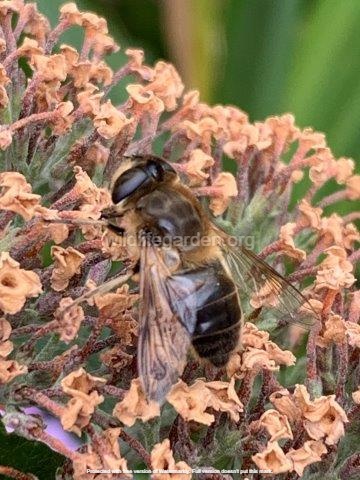
Family Syrphidae: Hoverflies
A very familiar and attractive family of flies belonging to the insect order Diptera (or True Flies). They have a single pair of wings, unlike most insect orders that have two pairs. Many species of hoverflies sport a yellow/black colour combination and are therefore often mistaken for bees or wasps, which many hoverflies attempt to mimic. However, they lack the ability to sting and are totally harmless.
With over 280 species recorded in the British Isles, most gardens will at some point in the year play host to more than one species. Many species are considered beneficial as their larvae feed throughout their development on aphids.
Interestingly, in most hoverfly species sex can be determined simply by looking at the hoverflies eyes. Usually if the eyes meet at the top of the head, then it’s a male; if separated then it’s a female. There area few species where this doesn’t hold true because they have males with eyes that are separated, however if they do meet you can be sure its a male.
Eristalis tenax
This species is one of the 10 present in the UK belonging to the genus Eristalis. According to Britain’s Hoverflies A Field Guide (*1), there are three characteristics that allow this species to be identified, and these are all nicely shown in the image below.
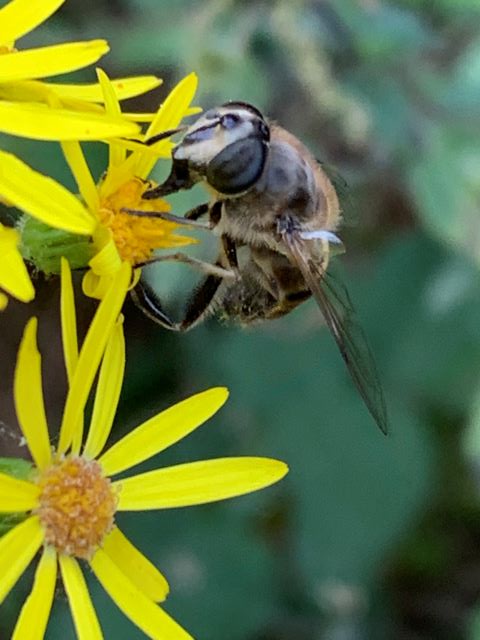
Firstly, note the thick black bar (stripe) down the centre of the face, which is thicker than in other species. Secondly, there is a vertical line down the centre of the eyes, which is actually a patch of hairs. Finally, the tibia of the back leg is swollen and curved.
The larvae are aquatic, the so called rat-tailed maggots, and are often seen in high nutrient situations, for example enriched ponds and slurry tanks.
A very common and widespread species. If you want to attract them, just create some enriched wet soil habitats. We’ve seen the attracted to buckets we forgot to empty containing compost, which soon becomes perfect for them as they fill with rain water.
*1 Ball, S & Morris, R. (2015)Britain’s Hoverflies A field guide. Oxfordshire: Princeton University Press
 Wildlife Garden