Date First Recorded in the Garden: 30/08/2021
Family Syrphidae: Hoverflies
A very familiar and attractive family of flies belonging to the insect order Diptera (or True Flies). They have a single pair of wings, unlike most insect orders that have two pairs. Many species of hoverflies sport a yellow/black colour combination and are therefore often mistaken for bees or wasps, which many hoverflies attempt to mimic. However, they lack the ability to sting and are totally harmless.
With over 280 species recorded in the British Isles, most gardens will at some point in the year play host to more than one species. Many species are considered beneficial as their larvae feed throughout their development on aphids.
Interestingly, in most hoverfly species sex can be determined simply by looking at the hoverflies eyes. Usually if the eyes meet at the top of the head, then it’s a male; if separated then it’s a female. There area few species where this doesn’t hold true because they have males with eyes that are separated, however if they do meet you can be sure its a male.
Chrysotoxum festivum
A relatively simple species to identify based on a few characteristics detailed nicely in Britain’s Hoverflies (*1). The yellow bars on the abdomen point backward but do not reach the very edge of the abdomen. Along with all six legs being completely orange helps confirm the species. Note also the dark smudge mark on the wing’s leading edge.
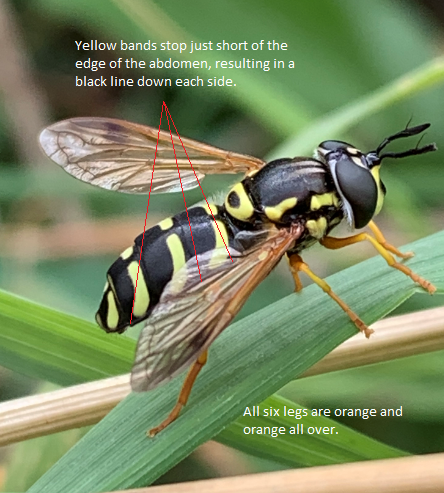
Just to be on the safe side, we did place the image opposite on the Hoverfly Recording Groups Facebook page (an excellent source of help), and its identification was confirmed. It is widespread and common in the south of England.
Overall, a striking visitor to the Garden, where it happily visits the oxeye daisies, wild carrot and knapweeds we have growing here. The larvae, according to some online sources, are suspected of feeding on root aphids.
*1: Ball, S & Morris, R. (2015)Britain’s Hoverflies A field guide. Oxfordshire: Princeton University Press.
 Wildlife Garden