Our August diary entry has been added to the Diary page. The month things became too over grown and nine new species added to our growing list.
The Downpour 26th August 2023
From time to time we like to talk about the weather. Yesterday we felt was note worthy enough to post about. At around 18:20 on August 26th 2023, I think it’s reasonable to say we had the heaviest rain we have seen in some time, certainly since launching this website. Having lived locally all my life (48yrs and counting) I genuinely cannot recollect a heavier individual downpour. Just have a look, the video fails to do it justice but you get the idea…
Avoiding the whole climate change debate, our immediate concern was with flooding. We have reported flooding of the Wildlife Garden in the past (click HERE for more info) and despite the Council having installed a significant soakaway in the lane behind the Garden, we still worried it wouldn’t stand up to this particular downpour.
Thankfully it did (well done Bristol City Council), and whilst there were the inevitable impacts of the pounding on the wildflowers, you can see from the aftermath shown in the video at around 2:20 minutes that visible impacts were minimal.
We are hopeful that the changes we have made to the Garden make it more resistent to flooding. Most the soil area is not walked on, hopefully relieving compaction, which is an issue in many gardens, helping worms go about their business of fixing the structure of the soil and allowing greater water penetration/storage. The roots of the larger woody species also help channel water deep down into the soil quickly.
The concern would be had this happened during a time when all soils/green surfaces were saturated, then the water in the streets, many of which flooded as a result of this downpour, could have been much worse. Damage to local large buildings attested to the fact that some of our infrastructure is not designed or too poorly maintained to handle very sudden and large quantities of water.
As a one off this downpour seems to have had little impacts that we can see or understand. This point of not understanding the issues is probably the most worrying aspect of all this.
If a point is reached and this type of rainfall becomes more frequent, even normal, we wonder how long before the Garden and the wider area floods more often with all the rain from the streets that has no free sewer into which it can run. Full of all sorts of nasties that will end up in the soils.
Flies – Other Than Hoverflies
When it comes to flies (Diptera) we have tended to focus on Hoverflies as they are so striking, obvious, easy to film and a favourite of ours in the Garden. However we have been focusing a little on other species lately and have uploaded two youtube shorts to support our pages on Sarcophaga sp (Flesh Flies) and Tachina fera (A Tachinid Fly).
So we thought we’d share these with you. Please click on the images below…
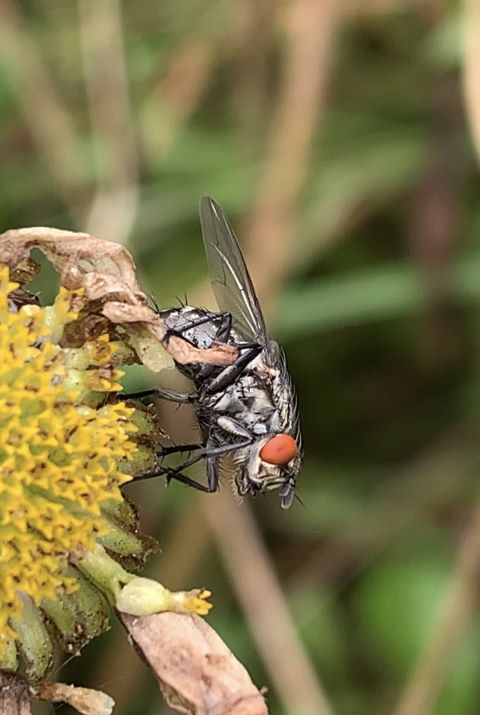
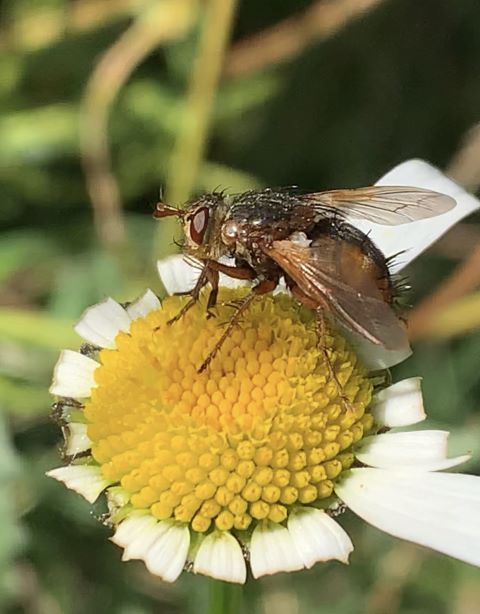
Tachina fera is a common species but one we have only just noted in the Garden for the first time this month. Sacophaga or Flesh Flies, are daily visitors to the Garden but there are several species which all appear the same and we are not sure which species visit us.
DC: 19/08/2023
July 2023
Our July 2023 update is on the website. Lots of new species and lots of rain. Including two species of Longhorn Beetle, the Ruby-tailed Wasp reported in our last post and a whole new Order of insects.
We’ve also added large thumbnail images to our species list, and where possible links to species accounts.
DC: 07/08/2023
Ruby-tailed Wasp
One of the main insects we have been waiting to record in the Garden finally showed up today, a Ruby-tailed Wasp. Think neon tetra (for those who like tropical fish) with wings and you’re on the right track. A spectacular looking insect belonging to the Cuckoo Wasp family Chrysididae. Our visitor was very happy foraging within the head of a Wild Carrot plant, as seen below.
Sadly we probably cannot identify this beyond the Family level, but its likely to belong to the genus Chrysis, Pseudomalus or Elampus. These guys are kleptoparasites, they deposit their eggs into the nest of a suitable host, often a bee species. The larva feed on the grubs and are then fed by the hosts themselves.
They are very small solitary wasps (not social) and easily overlooked despite their vivid colouration. We don’t believe they are under any particular threat in terms of current UK distribution.
DC: 23/07/2023
June 2023
Our June 2023 calendar entry is now on the website. Showing some of the new species recorded in the Garden. Plus highlighting the benefits of having uncut areas in terms of soil moisture rentention during prolonged hot dry spells.
https://wildlifegarden.org/june-2023/
If you’re considering starting a project to record wildlife in the garden and improve / increase the variety of the habitats you have available, now is not the time to begin making large wholesale changes as many species will be taking shelter from the heat and could be distrubed/displaced if you start moving things about or digging things up.
However you can do some simple things like provide water in small trays near any shrubs you have (ideally in partial/dappled shade so they don’t dry up to quickly). Simply add rocks to the tray until it is almost full and then fill with water to just below the top third of the stones so that creatures can rest and drink without actually entering the water. Place a few around the garden and fill with rain water if possible.
Spraying foliage with a hose set on mist will also help distribute water to those creatures that need it but are less mobile. Little and often is the best approach, just a very quick spray.
If you feed birds then remember to provide a little drinking station if possible, somewhere cats cannot get to of course.
Don’t turn compost heaps obviously. Top up ponds if needed. And don’t cut the grass. And remember, if things are dormant / sheltering from prolonged heat then after it rains the opposite will be true and you will find a visit to the garden a short while afterwards may yield some interesting wildlife finds.
DC: 03/07/2023
Welcome to the Jungle
Lots of new species recorded already this month in the Garden. It’s looking a bit wild down there…
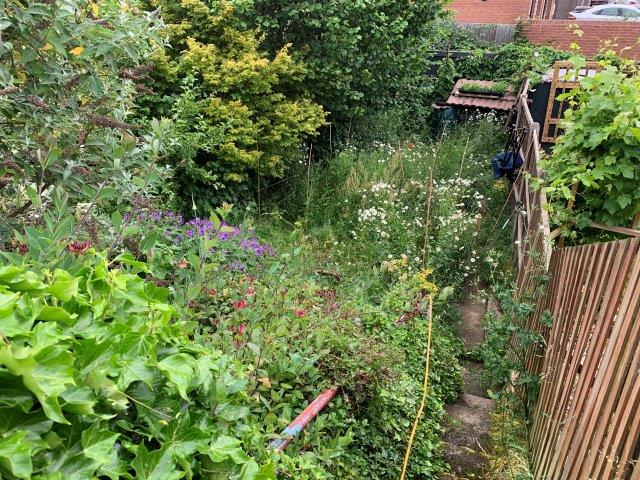
The Garden now has a good balance of fresh water areas, nectar sources, shaded leaf litter areas, varied vegetation structure and we hope improving soils. Plus a few bits of rock and rubble that a surprising amount of wildlife seems to be drawn to.
DC: 17.06.2023
Sphaerophoria scripta
A regular visitor came to the Garden on Monday and is one we always like to see and it’s nice to get the chance to film it for a while. A hoverfly with no common name we know of, so sticking with Latin it is known as Sphaerophoria scripta.
Our brief information page for this species can be found HERE.
DC: 17/06/2023
Megachile centuncularis Patchwork Leafcutter Bee
In November 2021 we briefly posted about a species of Megachile called Willughby’s Leafcutter Bee – Megachile willughbiella (click HERE to see post). We were unsure at the time if we had identified the species correctly and have not seen this species since in the Garden. However on the 9th June 2023 we recorded the following species, which immediately struck us as likely being something we hadn’t seen before. It had a different feel to it. So we crept slowly towards it and managed to get some images and video before it flew off next door.
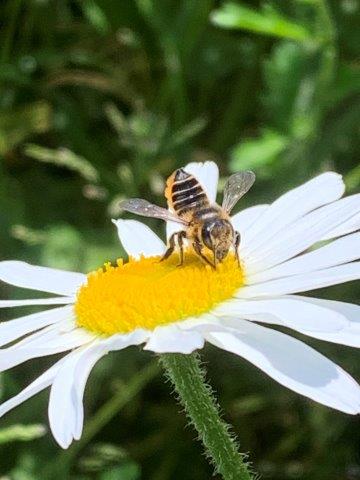
An amazingly neat species, with fantastically defined features. It was continually raising it’s abdomen, as can be seen in the image above, which we have read is something female Megachile centuncularis – Patchwork Leafcutter Bees tend to do.
The short video below shows more of the detail of this species, including the pollen brush, which forms the underside of the abdomen, and which in this species is orange to the very tip. Another clue this might be M. centuncularis 1*.
According to our Bee Book *1 this species is frequent and widespread in the South of England and gardens are noted as somewhere it is often recorded. So whilst we think we probably have the correct species, we will again mark this as Most Likely Species on the Garden list.
As for M. willughbiella – Willughby’s Leafcutter Bee, we still believe it to be a different species to the one recorded above and the most likely different species it could be is Willughby’s Leafcutter. So for now we will keep both species on the list.
DC: 10.06.2023
Ref 1*: Falk, S. (2016) Field Guide to the Bees of Great B
Swollen Thighed Beetles – Where are the females?
In our May 2023 entry posted just two days ago, we noted that whilst this year has been brilliant in terms of numbers of Swollen Thighed Beetles present, we were perplexed as to why we were only seeing males, which have the distinct swollen thighed (hind femora) appearance shown below, and never any females.
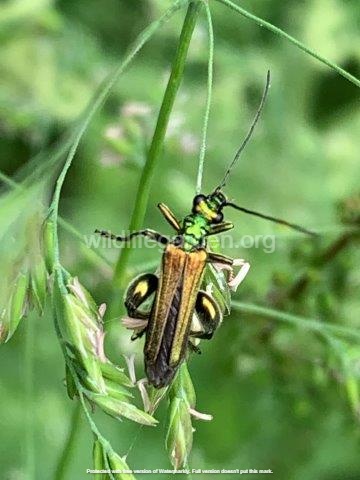
Well as always when posting something like this, the inevitable happened and the very next day females aplenty. Just to demonstrate this physical difference between the sexes we captured the following female resting on a oxeye daisy. As can be seen her hind legs are much like the others and not dramatically swollen.
This of course does pose the question, why do the genders differ in this way? Well the answer perhaps unsurprisingly seems to have something to do with mating. Not an activity we have yet witnessed in the garden, although as the ladies only turned up yesterday this is perhaps not surprising.
DC: 04/06/2023
 Wildlife Garden