Moth Trapping – June 11th

With more cool and wet weather predicted for the middle part of June, we took the opportunity when the weatherman forecast dry weather on the 11th – 12th June to put out our moth trap. It was a cool night and there was a decent breeze about.

Despite conditions not being great we did have some success. In particular attracting two previously unrecorded moths to the Garden. The full list of moths recorded was as follows;

Willow Beauty (x5), Eudonia lacustrata (x2), Rustic Shoulder Knot (x1), Heart And Dart (x3), Common Marbled Carpet (x1), Buff Tip (x1), Heart And Club (x1), Buff Ermine (x2), Setaceous Hebrew Character (x1), Clay Triple Lines (x1) and finally Metalampra italica (x1).

The final two species listed are the new garden records. Clay Triple Lines, or more accurately Cyclophora linearia, is relatively common in the South of England at this time of year (its first brood). Its larva feed on beech.

12.06.2024

Clay Triple Lines: It is a member of the family Geometridae, and is the third species of the genus Cyclophora recorded in the Garden to date. The others being Maidens Blush (C. punctaria) and The Mocha (C. annularia).

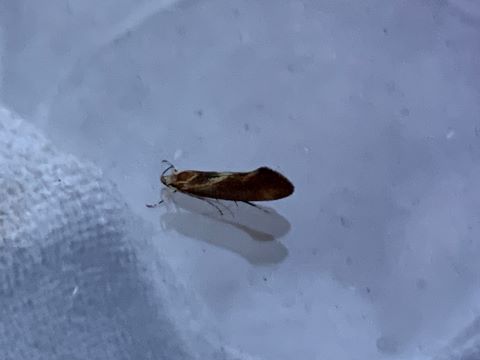
The second new species, Metalampra italica, is interesting in that it was only first recorded in the UK 2003 in Devon but reports seem to suggest it has been spreading ever since. It’s a rather attractive little micro moth belonging to the Family Oecophoridae, which is the same family to which Brown House Moths belong.

Metalampra italica: According to the UK Moths Website this species, also known as the Italian Bark Moth, is associated with oak deadwood.
We do hope to moth trap more this summer, but with the weather looking very unpredictable for the next week or two we may have to wait a little while.

DC:14.06.2024
Playing Dead Behaviour

Have you ever heard the phrase ‘Thanatosis’ or ‘Tonic Immobility’? We certainly hadn’t until we filmed the Green Weevil below, seemingly playing dead upon being discovered.

Phyllobius sp (A Green Weevil) – 16th May 2024

We have to admit to being slightly baffled by this behavior. After all, how could this possibly help prevent a predator attack, or for that matter any other form of threat? A quick search online and we think we have the answer.

The act of thanatosis, or playing ‘feigning’ death, is apparently common in the animal kingdom, and many different phyla of animals exhibit this behavior. In invertebrates and in arthropods in particular, according to Wikipedia, the defensive purpose of tonic immobility is that many predators only catch live prey, so pretending to be dead deters certain would-be attackers. Although it should be added that different types of animals have different reasons to feign death, and this behaviour is different from that seen when scared animals, such as deer, freeze on the spot.

Interestingly, this is also common in many species of spiders, which upon reflection, we have probably witnessed without really thinking about it. Just think of the times you may have disturbed a spider and suddenly it is on its back, legs retracting to form a tight ball as if dead. Almost as if you had already killed it by accident.

Worth remembering next time you come across a seemingly dead arthropod, try to be gentle when putting it outside. Perhaps go steady with the old dustpan and brush, just in case it is only faking it.

DC: 12.06.2024

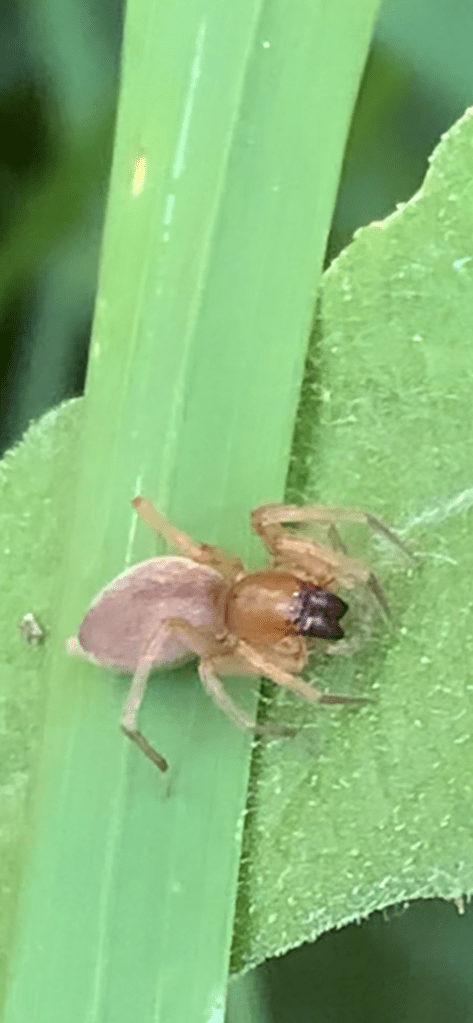
Our 25th Spider Species

Recently we recorded our 25th species of Spider (Araneae) in the Garden. In the grand scheme of things this is a low number, when compared to the 650+ species known to live in the UK. However for a small urban garden we think this is a rather diverse group. Especially as spiders are not something we actively look for. Indeed many would say the opposite is true. However spiders are generally very shy creatures (apart from Zebra Spiders which we have stated elsewhere on this website are down-right nosey) and it should be remembered that they capture/hunt many of the other species we consider annoying.

Unfortunately we have not been able to identify our 25th species beyond genus level, so Clubiona sp it will have to remain unless someone can positively identify it for us.

Clubiona spiders are known as Sac Spiders, because the females are sometimes seen guarding their egg sacs within a silken den. In general the members of this genus are nocturnal hunters*, which may account for why it has taken us so long to spot them.

There are around 20 species of Clubiona in Great Britain, many are relatively common and many look like our specimen above.

DC: 12.06.2024

* Bee, L & Oxford G & Smith H. (2020) Britain’s Spiders: A field Guide. Second edition. Oxfordshire: Princeton University Press

Odonata old and new – Beautiful Demoiselle & Large Red Damselfly

Calopteryx virgo & Pyrrhosoma nymphula

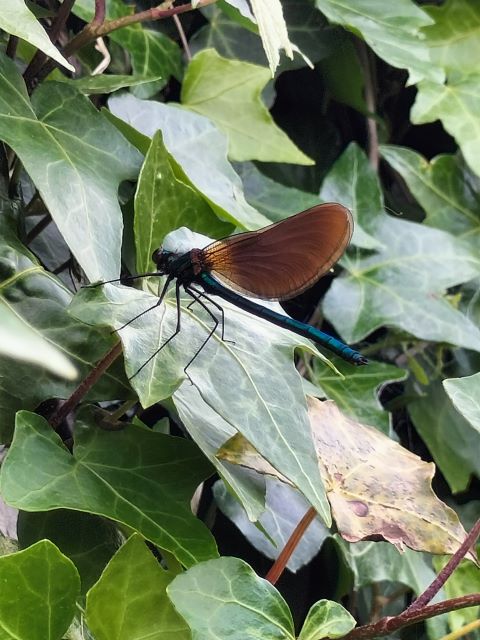
The order Odonata includes the well-known Dragonflies and Damselflies, but also the less well-known Demoiselles, of which there are two species in the UK. On the 10th May, we finally welcomed our first visit from the aptly named Beautiful Demoiselle (Calopteryx virgo), pictured below resting upon some ivy. This particular individual is a female, easily distinguished from the male by the color of her amazing wings, males having much darker ones.

10.05.2024
10th May 2024

Demoiselles begin their life cycle in flowing water as an egg laid on water weeds, and the aquatic larva develop within the flowing fresh water habitat over a period of two years, hunting within the depths for small prey. As such this species will only be visiting the Garden as an adult, searching for food on the wing. It has most likely travelled from the nearby nature reserves surrounding the River Avon or Brislington Brook. Therefore unless you are lucky enough to have a stream running through your garden there is probably little you can do to acttract this species to permanently set up residence with you.

However, there are species of Odonata that you can attract to your garden with only a small area of standing fresh water. And we have been lucky enough to recently confirm that the Large Red Damselfly does indeed breed in our Garden.

06.05.2024
6th May 2024

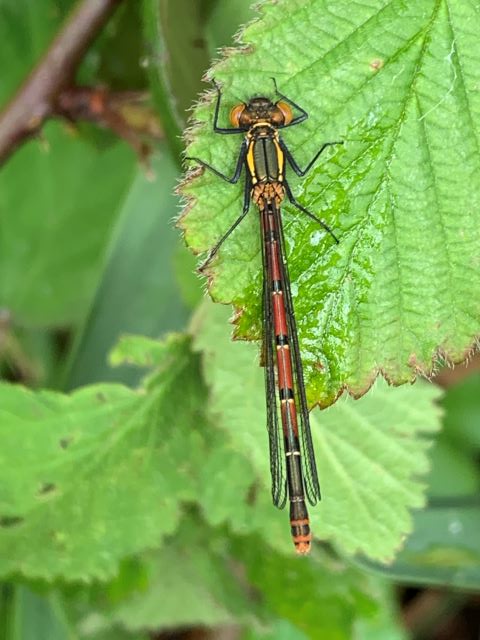
On the 6th May we spotted the above Large Red resting on some bramble, again this is a female. We were not especially suprised as this species often visits the Garden in spring so we were expecting it. This lady even let us film her for a short while…

6th May 2024

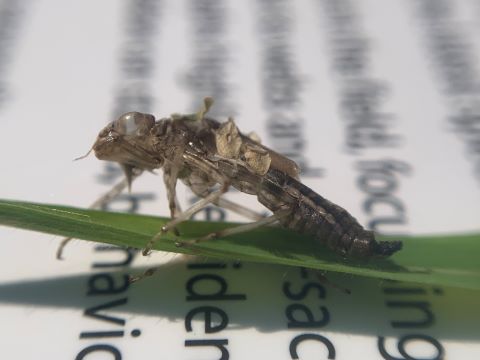
We started to see these guys in good numbers and suspected they might be emerging from somewhere close by and checked our boggy area as it currently contains the only fresh water with emergent stems currently in the Garden and up which the larva finally ascend to become adults. And bingo!!!

8th May 2024

…and of course we popped back later to get a photograph of the shed skin or exuvia as it is called…

08.05.2024a
8th May 2024

There is another species of Red Damselfly that may be about in the area, the Small Red Damselfly. Thankfully they are easy to tell apart from the Large Red as they have red legs whilst as you can see the Large Red has entirely black ones.

So another reason why it’s good to have some standing water areas in the Garden, not only do they offer hydration for a wide variety of animals, they are also where some animals call home.

DC: 14.05.2024

The Green Cellar Slug & The Jackdaw

The Green Cellar Slug – Limacus maculatus

We don’t talk about slugs very much, no one does really. Indeed if you find yourself involved in a coversation about them it’s usually either because someone is trying to kill them or one has left a slimey trail across your new garden furniture (it’ll wash off!). So it is nice to add another species of slug to the Garden species list by saying hello to the Green Cellar Slug. Isn’t he fabulous!

Green Cellar Slug
4th May 2024

In a dark and damp corner of the Garden we had stored, for some considerable time, an unassembled and still boxed wooden planter. We just never found a use for it. Well yesterday we decided to peel off the rotting cardboard and put the thing together and found this fabulous individual hiding inside.

4th May 2024

It’s one of two similar species, the other being the Yellow Cellar Slug, which we are yet to record in the Garden. The Yellow Cellar Slug or Limacus flavus, a species long recorded in the UK, is believed to be dropping in abundance. Possibly being replaced by the much more recently noted species L. maculatus. It may even be the two species are hybridizing. There seems to have been in recent years a campaign to discover what the true picture is regarding the fate of the Yellow Cellar Slug, but we couldn’t find the results of the study.

In any case, the Green Cellar Slug has been growing in distribution and like the Yellow is frequently found in gardens where it feeds on the usual variety of rotting vegetation, fungus and yes, the odd growing seedling. Although we have yet to see one feed ourselves.

The Jackdaw – Coloeus monedula

Every so often we see a familar species and think something like, “Good morning Mr *enter species here*, how are you today?” (it’s nearly always a Mr, don’t know why) and then it suddenly dawns that we’ve never added this species to our Garden list. That seems to have been the case for the Jackdaw, which we spotted on the garden fence this morning (5th May) whilst cutting back some ivy.

Adding the Jackdaw now means that of the five corvid species we regularly see in the surrounding area, we have three recorded in the Garden. The other two being Carrion Crow and Magpie. The two local species not recorded yet are Rook, which we have never seen land in the Garden and Jay which we think we may have but cannot be sure.

So there you have it! Two species new to the Garden species list, but who have almost certainly been here all along as either a resident, which the Green Cellar Slug is most likely, or a visitor in the case of the Jackdaw. Garden wildlife can be so abundant that we take many species for granted, we are lucky this is the case. It may not always be.

DC: 05.05.2024

A new Hoverfly, Butterfly and Bird

It’s only April and we have had some amazing wildlife in the Garden already. The latest trio of newcomers started with a species of hoverfly, the 25th hoverfly species recorded in the Garden so far, called Pipiza noctiluca. It is slightly unusual looking for a hoverfly…

The British list of Pipiza runs to seven species, which can be difficult to identify. The rather plump female that visited us has two obvious yellow spots on the second tergite suggesting P. noctiluca. We have attached some footage at the end of this post should anyone be able to absolutely confirm this species identity.

The larvae are aphid eaters, like so many other hoverfly species, although apparently the larvae from this genus like to feed on aphids in confined spaces, such as leaf rolls/galls.

Our next new arrival is one we have waited on for some time. Our 15th confirmed butterfly species, the amazing Orange-tip Butterfly. It was a breezy day which doesn’t make for the best filming conditions, but the gusts did seem to convince this individual to sit still long enough to be filmed.

20th April 2024

Only the males have these amazing orange tips to their wings. This is a species typical of woodland edge/ride habitat but can be found in many other places, including meadows and gardens.

Our final new visitor, which we unfortunately failed to photograph, was the stunning Goldcrest. A common enough bird but one we haven’t seen in the Garden since 2021 when we started this project. According to the RSPB’s website, this species, along with the similar Firecrest, is the UK’s smallest bird, weighing in at just 6 grams. For some perspective, a tablespoon of sugar weighs approximately 12 grams.

Pipiza noctiluca

DC: 24.04.2024

Earwigs – what are they up to?

Back on the 18th March we came across the following…

Earwig

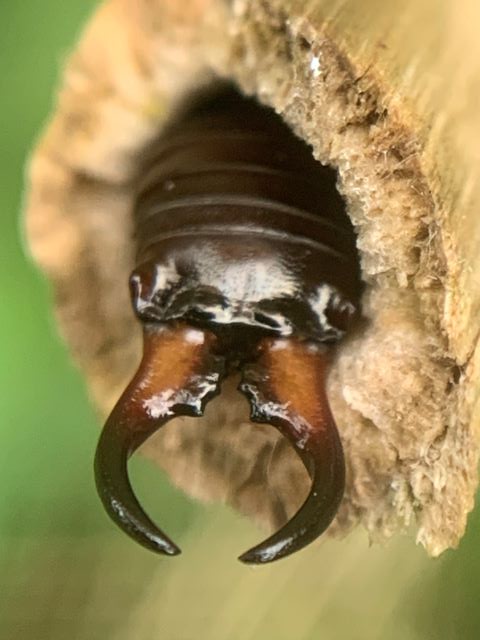
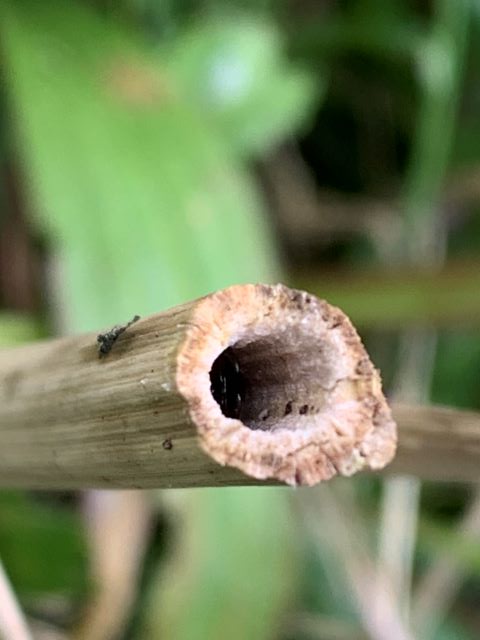
An earwig jammed into a hollow stem within the meadow area. What was not immediately clear was whether it was there by its own volition, or whether something more sinister was at play.

So we sat and watched to try and figure out what was going on and filmed the following, which looked to us as if the individual was a) still alive and b) being pulled into the stem.

Short clip showing earwig in hollow stem

We know Earwigs are predominantly nocturnal, so thought perhaps it was looking for shelter, but this seemed such an unlikely place. The following day and the little fella was still in the stem, only now much further in and much more tightly stuck it seemed.

You’ll have to look closely, you can just about see its pincers, curved inwards which suggests this is a male. So much for the nocturnal idea we thought.

Earwig

We did wonder if this was a potential nesting situation but of course this is a male, and whilst earwigs do look after their young, this is primarily a female activity. Also, mating tends to occur during the autumn, with males apparently leaving the nest early the following year. So in truth we were stuck, and not knowing what was going on (knowing little about earwigs) we promptly forgot about it. Then exactly one month later we spotted exactly the same thing again…

earwig
18th April 2024

We are now back to favouring the simplest of answers, that this is just a good place for earwigs to hide until night time.

DC: 20.04.2024

Esperia sulphurella – Hiding in plain sight

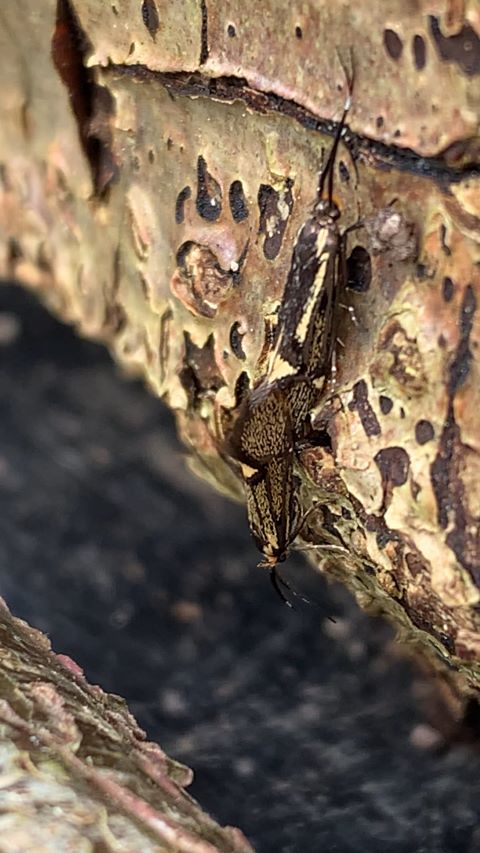
We just happened to look in the right direction to spot this pair of mating Esperia sulphurella, which we thought blended into this old deadwood branch amazingly, especially in terms of the colouration.

mating
16th April 2024

We regularly see this species, but rarely male and female together. The female will lay her eggs just beneath a loose piece of bark or within a rotten cavity from which the caterpillar will feast on the deadwood itself.

Deadwood is a valuable resource for many invertebrates and generally lacking from urban gardens due to ‘human garden tidy syndrome’ or unsuitable. Unsuitable deadwood can be treated timber, which may contain preservatives that are not invertebrate safe. Indeed are designed to eliminate wood-boring insects and other invertebrates. If you do happen to have any natural/untreated deadwood, try keeping some in the garden somewhere, ideally scattered in different locations offering different conditions (sun, shade, damp, dry, ground level or elevated etc).

DC: 16.04.2024

Two new Hoverfly Species

We’ve had some sunshine recently in Bristol (UK) and this has encouraged a good number of insects to take to the wing. Including, we are delighted to say, several hoverfly species, including two species new to the Garden.

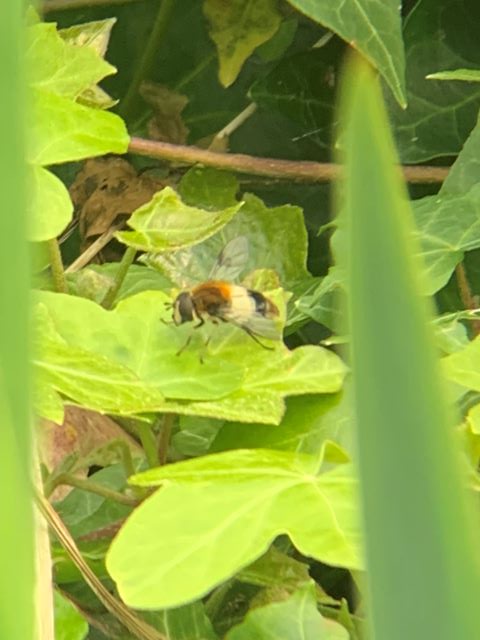
On the 13th April we spied within the bramble and hazel, resting on some ivy, something unfamiliar. Sadly the only image we could get was through the lens of our binoculars, but even from this poor image we could tell this was Leucozona lucorum. A widespread and fairly common species.

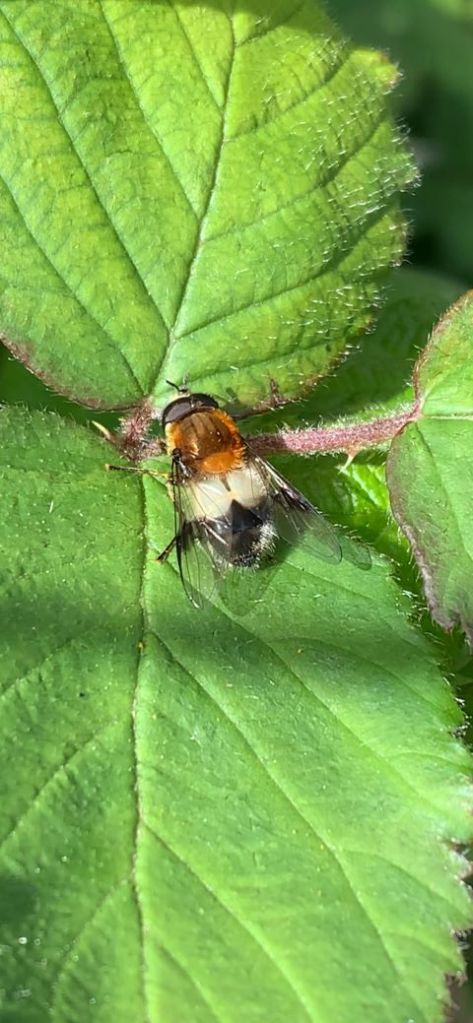
The next day we recorded another individual and managed to get a much clearer image. As you can see, this isn’t a typical looking hoverfly. There are two other species of Leucozona recorded in the UK, but neither look like this one, so we can be confident in its identification.

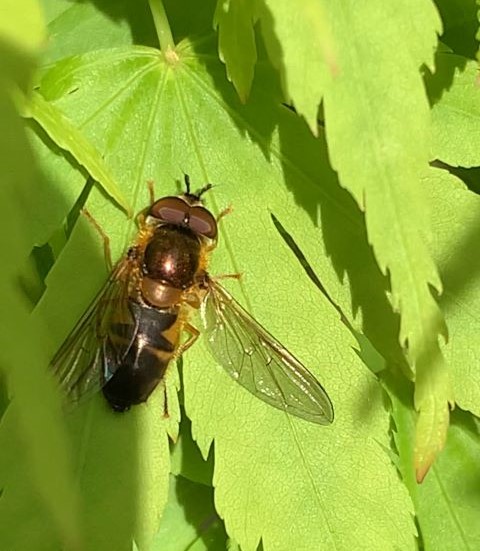
Then on the 14th of April 2024 we noted what we thought was an Eristalis species sunning itself on the Maple.

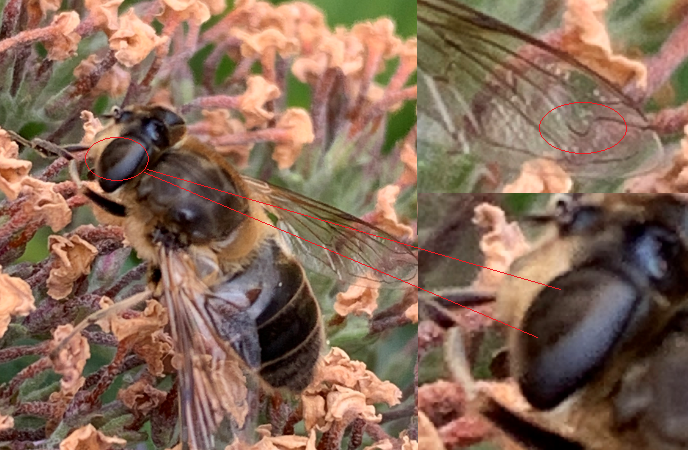
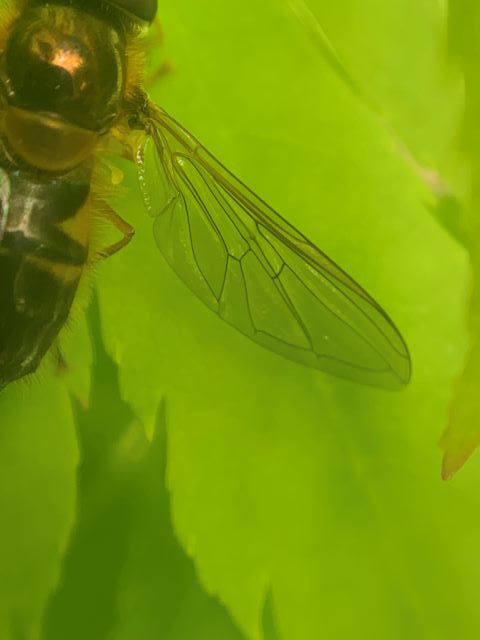
Conveniently it had one of its wings held out at a right angle, and we noticed something odd. It didn’t have what is known as the R4+5 Vein Loop, something all Eristalis species have. The trio of images below are of Eristalis tenax, otherwise known as the Drone Fly. The top right image below shows the vein loop circled in close-up.

Our new visitors outheld wing clearly shows no such loop, meaning this species was from a genus other than Eristalis.

It turns out to be a species called Epistrophe eligans. We’ve probably been overlooking this common species all along, thinking it to be Eristalis pertinax which looks similar.

So we ended the day with our 24th species from the Family Syrphidae (Hoverflies), and no doubt there will be other species recorded in the future.

Hoverflies are a simple way to begin to explore a garden’s biodiversity as they are mostly recognizable as hoverflies and generally easy to capture or photograph. Many can be identified to species level with little difficulty, more with a little practice. There are a number of very good books available to help with identification, our favourite being:

Ball, S & Morris, R. (2015)Britain’s Hoverflies A field guide. Oxfordshire: Princeton University Press

Attracting passing adult hoverflies requires nothing more than a food source. In the USA Hoverflies are known as Flower Flies, and for very good reason. Suitable flowers are generally ones where the nectar is easy to get to without the need for a long proboscis (which flies lack). Wild Carrot, Oxeye Daisy, and Green Alkanet are native flowers that can be used to attract them. California Lilac is a good non-native shrub that isn’t (yet) invasive and attracts good numbers also.

The larvae feed on many different things, but many are aphid feeders, so plants like Hazel which attract large numbers of aphids are a good bet.

DC: 14.04.2024

Species No. 600 – Oulema sp

Our 600th species recorded in the Garden. In truth, it is likely one of either two species, Oulema melanopus or O. duftschmidi. A popular species identification App we use suggests O. melanopus, but it seems unlikely the App is sophisticated enough to distinguish between these two closely related species.

It’s a beetle in the family Chrysomelidae, and is native to Europe and Asia. It is notorious as a pest in parts of its native range as well as North America and its common name is the Cereal Leaf Beetle due to the damage it causes to oats, barley, wheat and other cereal crops.

As with many species considered ‘pests’ there is a wealth of information available online regarding its life cycle. It overwinters as an adult and this is likely why we are seeing one so early in the calendar year. We certainly don’t recall seeing this species before, so expect it has arrived from wherever it spent the winter.

DC: 14.04.2024