Myathropa florea
Date First Recorded in the Garden: 05/06/2021
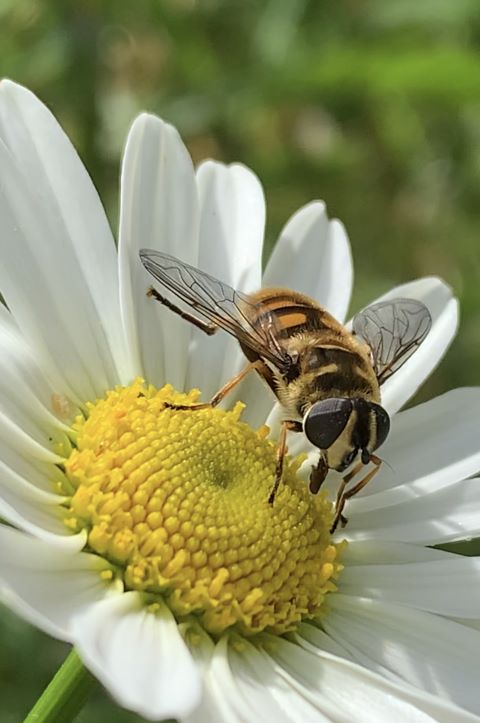
Family Syrphidae: Hoverflies
A very familiar and attractive family of flies belonging to the insect order Diptera (or True Flies). They have a single pair of wings, unlike most insect orders that have two pairs. Many species of hoverflies sport a yellow/black colour combination and are therefore often mistaken for bees or wasps, which many hoverflies attempt to mimic. However, they lack the ability to sting and are totally harmless.
With over 280 species recorded in the British Isles, most gardens will at some point in the year play host to more than one species. Many species are considered beneficial as their larvae feed throughout their development on aphids.
Interestingly, in most hoverfly species sex can be determined simply by looking at the hoverflies eyes. Usually if the eyes meet at the top of the head, then it’s a male; if separated then it’s a female. There area few species where this doesn’t hold true because they have males with eyes that are separated, however if they do meet you can be sure its a male.
Batman Hoverfly – Myathropa florea
Myathropa florea is the UK’s only representative of the genus Myathropa and is a very common and widespread species. It’s one of the most frequently recorded species of hoverfly found in the Garden and often one of the easiest to photograph.
The Batman Hoverfly English name refers to the Batman sign / pattern that can clearly be seen on the thorax of the adults, as shown below.
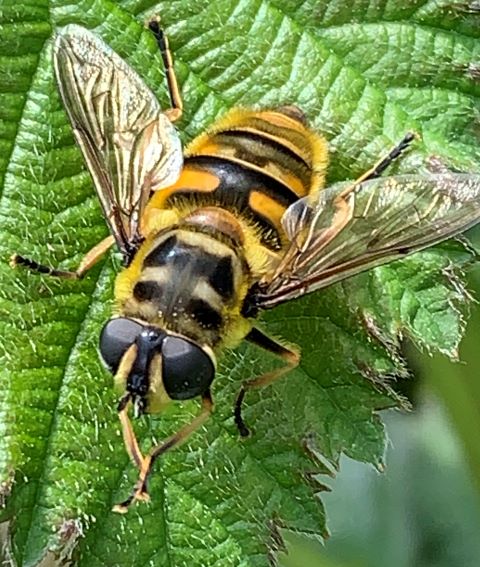
As you can see from the above image, this individuals eye’s do not meet at the top of the head, marking this individual as a female. If you view the you tube short below and pause the footage with the hoverfly facing the camera, note how the eyes meet at the top, marking this as a male of the species (apologies for the Latin spelling mistake in the short, auto corrected unfortunately).
And here is a short movie of the female for comparison…
In the Garden
M.florea is one of a few hoverfly species which develop in wet/rotten vegetation, which is often anaerobic (lacking oxygen) due to the action of microorganisms found in such habitats, think of decaying wood / rot holes in trees. Unlike most hoverfly larva which are often found wandering across leaves, eating aphids. The larva of M.florea and several other species, have larva which have developed a tube through which they can breath air. This tube, poking out of the larva gives rise to the name ‘rat-tailed maggot’.
You can readily encourage this species to your garden but taking a spare bucket, filling it up to two thirds with leaves, twigs and clippings and then filling the whole thing up with rain water and place it within dappled shade throughout the spring summer. This will act as a safe drinking vessel for inverts (they can perch of the rotting but floating vegetation) and also a place for these rat-tailed larva to develop.
We have from time to time noted that some females, will lay their eggs in what could be described as sub-optimal locations. As seen here on the 14th July 2024 when we noted this individual laying eggs a seed tray. Whilst the compost was wet at the time, often these seed tray cells dry out, something of course the hoverfly will be unaware of.
Another reason perhaps to ensure you have as wide a variety of habitats/niches present as possible in your garden for as many species to find suitable conditions to fulfil their full life cycle.
Just having a few wildflowers growing in the garden will attract the adults, like so many other species oxeye daisies seem to be a favourite.
 Wildlife Garden