There are only six native species of amphibians on mainland Britain and most gardens have or can easily be adapted to attract and maintain a small population of at least one of them. Only the most manicured of gardens would struggle to do so.
There are six native species of amphibian in Great Britain and currently we have Garden records of half of them, The Common Frog, The Common Toad and most recently the Palmate Newt. Common Frogs have been a constant presence in the Garden since we moved in in 2004. Common Toads were also regular visitors however rather worryingly we have not seen a Toad since this Garden Project began in May 2021.
The most recently recorded new species is the Palmate Newt. We have recorded newts in the Garden before, including in 2020 in the old small wildlife pond we recently replaced (2023) with a larger one. However until now we have been unable to identify the species. Click on the newt image below to visit our species account for Palmate Newts.
Note: We have recently discovered that unlike frog tadpoles which develop lungs early on and can gulp air from the ponds surface when the oxygen levels in the water are low, toad tadpoles don’t develop lungs in this way until later in their development *. The result of which is that in small eutrophic ponds with low oxygen levels, toads struggle to survive. Considering it was around 2019/2020 that we first knew that the conditions in the pond had deteriorated due to the build up of organic matter (sludge) to the point that eutrophication was rendering the pond almost void of larger life. Then perhaps Common Toads have not been recorded simply because conditions did not allow. Also worth noting eutrophication is a natural part of the ponds life cycle but in the wider countryside human activity, such as agricultural inputs, can speed up the process. Another great reason for those of us fortunate to have a garden to create ponds suitable for wildlife.
What can we do to encourage amphibians into the Garden
Most of us are aware that amphibians live a dual life, partly aquatic and partly terrestrial. They also have one major challenge: their skin is not waterproof. When in water, their bodies absorb water due to concentration gradients, and when out of water, they are at risk of dehydration.
Aquatic Life: In terms of their aquatic life, there is little we can do other than provide unpolluted, safe, and undisturbed ponds or other wet areas in which amphibians can breed, and their larval stages can develop. For a healthy amphibian, this is all they need, as they can get around the issue of water absorption simply by excreting the excess absorbed water as urine. This prevents them from becoming bloated.
Our first small garden wildlife pond was created over 15 years ago on the middle level of the Garden. It supported frogs, toads and eventually newts up to around 2021/22. By which time it had become stagnent, hypereutrophic and for all intents and purposes not fit for larger life to survive. Over the winter of 2023/24 we are replacing this small pond with a larger one. In the meantime the small pond in the boggy area (see point 2 below) will be suitable for breeding amphibians (frogs at least, see note above) in Spring 2024. But also worth noting frogs do breed in the fish pond on the top level of the Garden.
Terrestrial Life: On land, things get more complicated. It would seem likely that we have now entered a period when extreme weather events, including prolonged dry spells/droughts, will become more common. What is therefore needed is a habitat where soils can remain damp and the amphibians can be safe from other threats, including domestic cats.
We have three areas of the Garden, away from the pond itself, where we have created such places:
- We find more frogs beneath the tree / shrub border at the bottom of the fence, than anywhere else in the Garden. Here dead leaves from the deciduous canopy above gather creating a deep layer of compost, which is shaded by the above canopy during summer and just a few cm beneath the surface remains damp throughout much of the year. We have added logs, sticks and cut brambles along parts of this border to put cats off resting there and to provide additional protection for our amphibian residents.
- We created the Boggy/Wetland area (click HERE for more details). This area is exposed to sunlight throughout the year, but only during prolonged warm periods does it completely dry up due to a pond liner a few cm beneath the surface preventing what rain has occurred from draining away. We have also placed a couple of old roof tiles half buried in the mud under which we hope amphibians can find refuge. These we allow to become overgrown with long grass to keep conditions cooler.
- The wildlife hotel. We created a small basement level (click HERE for more details) specifically for amphibians to find shelter. Although we have no way of checking if amphibians use this space.
Frogs and Toads both have areas of skin which can actually absorb water when in contact with damp soil. This allows for a degree of rehydration and considering neither can ‘drink’ water directly, providing this resource in places around the garden is important.
Of course these are all well and good and they do work, but inevitably amphibians know best what amphibians want and you will just as likely find them sheltering behind a planter or under garden furniture if they can find a suitable spot. The important thing to do is try not to disturb them especially during hot weather, unless they are clearly in trouble.
Amphibians and other threats: Amphibians, whilst being larger than most animals found in the Garden are of course prone to predation at all stages of life. Water beetles for example will attack larva and even froglets. Birds and small mammals such as a hedgehog may also predate amphibians. One particular problem is cats, who seem to capture frogs and toads then either immediately regret it or use the animals as a play thing. We believe the injured frog below was attacked by a cat.
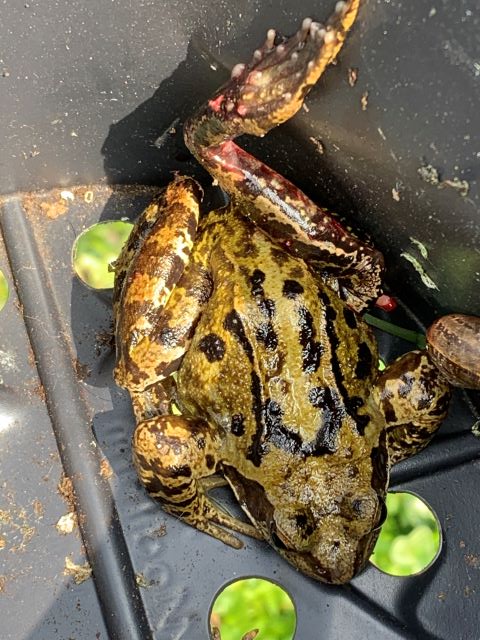
Birds will also eat tadpoles, but then again tadpoles will eat tadpoles and without trying to sound to lofty about it, this is all in the natural order of things.
Mowing or strimming the grass in the garden is another and potentially massive threat to young and adult amphibians, especially when the froglets are leaving the pond during the summer. Lots of advice online, including mowing slowly, beating the grass at a high level to frighten froglets away. Keeping the areas you want cut, cut very short at all times.
Our approach is the opposite to this last one. We are seeing how we get on not cutting the meadow area at all, although we may select an area in the future and keep it cut short so we have somewhere to sit. What we do is occasionally use shears to cut some areas or “hand graze” as we like to call it. Hand grazing simply involves every now and then randomly grabbing a handful of vegetation and ripping it up, as if being grazed by a herbivore in the wild. The results are not pretty but do create a varied structure and I’m pretty sure no amphibians or anything else for that matter is being harmed.
Summary: So to bring that all together. Consider the needs of amphibians at all stages of their development and life cycle. Ponds are obviously important, and for toads, healthy water conditions are especially vital. Damp, undisturbed terrestrial habitats are key, and ideally places where domestic animals, in particular cats, would generally avoid. Grass cutting is considered vital for many gardens. Keeping lawns short will discourage amphibians and therefore prevent them from being harmed. However, short lawns will be more susceptible to drought. Leave uncut areas and where these need occasional cutting, consider how best to do this (see above).
*Beebee, T. Griffiths, R. (2000) Amphibians & Reptiles. New Naturalist. HarperCollins Publishers, London.
 Wildlife Garden