We’ve had a few new species in the Garden during April, and the following two have very little in common, one being a True Bug and the other a Beetle. Apart, that is, from their vernacular name being Tortoise.
The Tortoise Beetle, recorded on the 20th April 2025.
These odd but very pretty looking beetles can be easily overlooked. They are well camouflaged and have a sort of glistening/metallic green/yellow appearance. This mating pair was recorded on one of their many food plants, Black Knapweed.
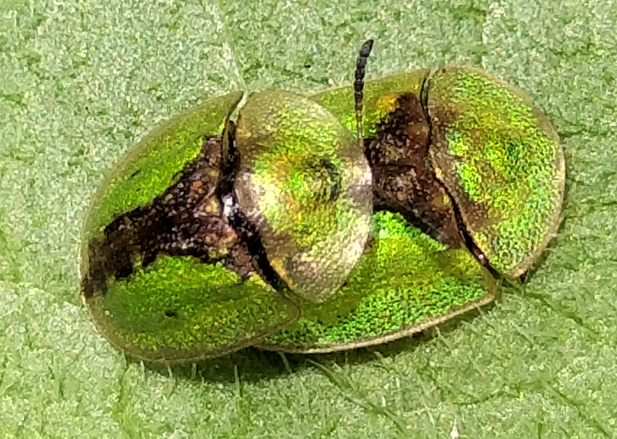
Their Latin name is Cassida vibex, and there are only a few native species from the genus Cassida recorded in Great Britain. This species is generally easy enough to identify due to that dark band running down the elytra, and when present, note the black spots on either side of the elytra.
Most of the ‘bits’ you cannot see are where you would otherwise expect them to be. The beetle, of course, has eyes and antennae, but these are all safely tucked up underneath for protection. When not mating, an individual, if threatened, can completely flatten itself against the leaf surface, forming a tight seal.
Our second Tortoise, recorded a few days later on the 28th April 2025, was the Tortoise Bug. Not a beetle this time, but a species of true bug belonging to the order Hemiptera. This shield bug (what Americans call stink bugs) initially confused us, as we thought it was a Sloe Bug, but it had something ‘different’ about it.
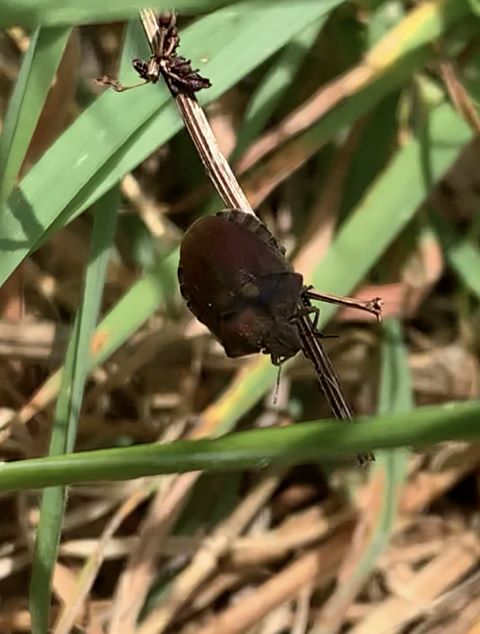
It’s latin name is Eurygaster testudinaria, and according to some online sites it is doing rather well and becoming more common, especially in the south of England where we are.
We had to trap the little guy before we were able to determine the species. If you look at the video below, you will notice, at around 18 seconds, that the antennae are black for the final two segments, a feature of this species. There is really only one other species it can be mistaken for, but this is rather rare and lacks the central indentation you can see in the center of our specimen’s head.
The bug was quickly returned to the Garden where we found it.
So, two new species for the garden. We have a couple more that we will add to the website when we find a bit of time.
DC: 03.05.2025
 Wildlife Garden