We’ve had some sunshine recently in Bristol (UK) and this has encouraged a good number of insects to take to the wing. Including, we are delighted to say, several hoverfly species, including two species new to the Garden.
On the 13th April we spied within the bramble and hazel, resting on some ivy, something unfamiliar. Sadly the only image we could get was through the lens of our binoculars, but even from this poor image we could tell this was Leucozona lucorum. A widespread and fairly common species.
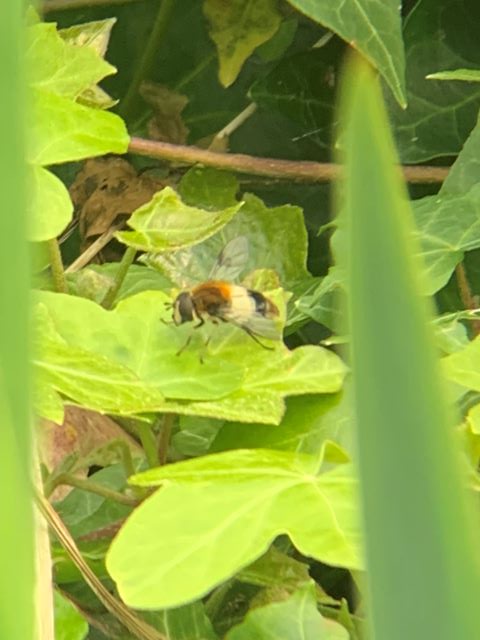
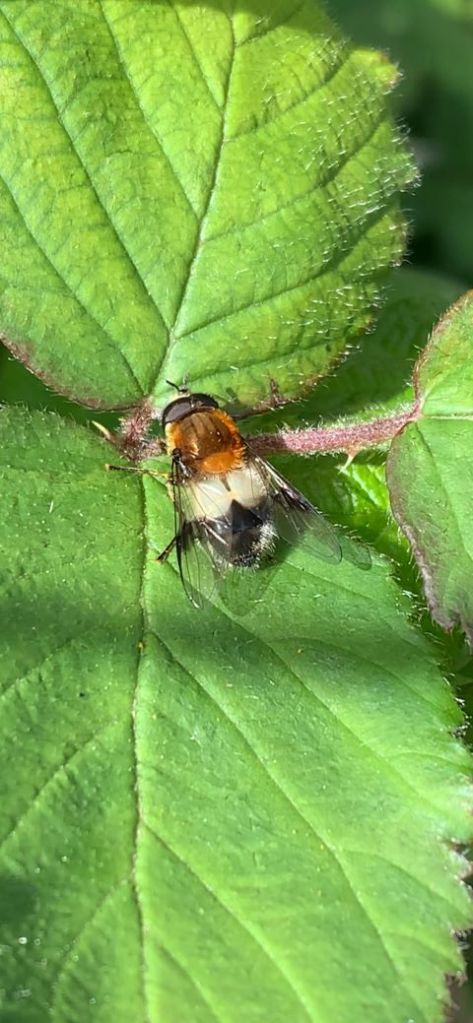
The next day we recorded another individual and managed to get a much clearer image. As you can see, this isn’t a typical looking hoverfly. There are two other species of Leucozona recorded in the UK, but neither look like this one, so we can be confident in its identification.
Then on the 14th of April 2024 we noted what we thought was an Eristalis species sunning itself on the Maple.
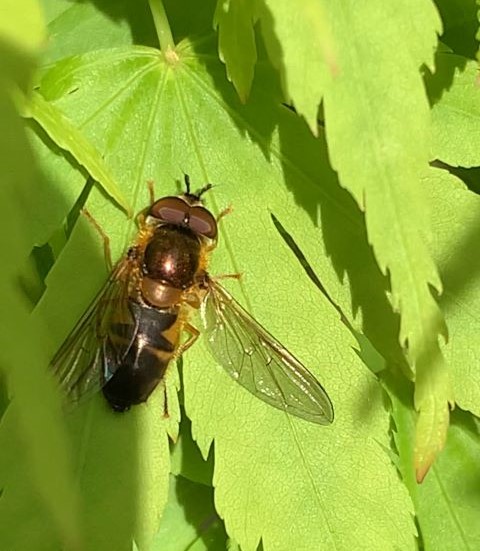
Conveniently it had one of its wings held out at a right angle, and we noticed something odd. It didn’t have what is known as the R4+5 Vein Loop, something all Eristalis species have. The trio of images below are of Eristalis tenax, otherwise known as the Drone Fly. The top right image below shows the vein loop circled in close-up.
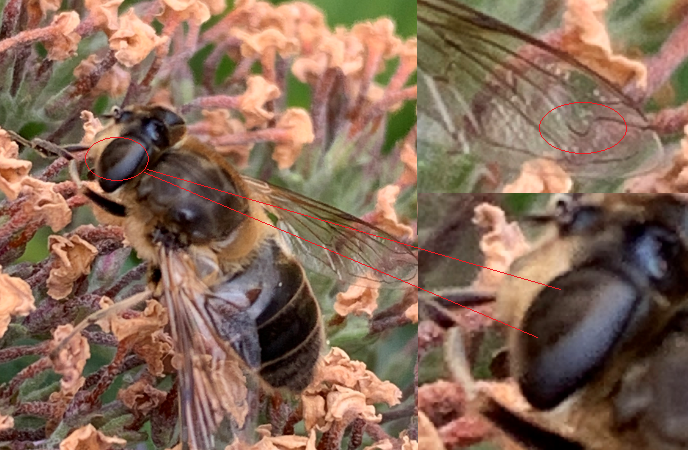
Our new visitors outheld wing clearly shows no such loop, meaning this species was from a genus other than Eristalis.
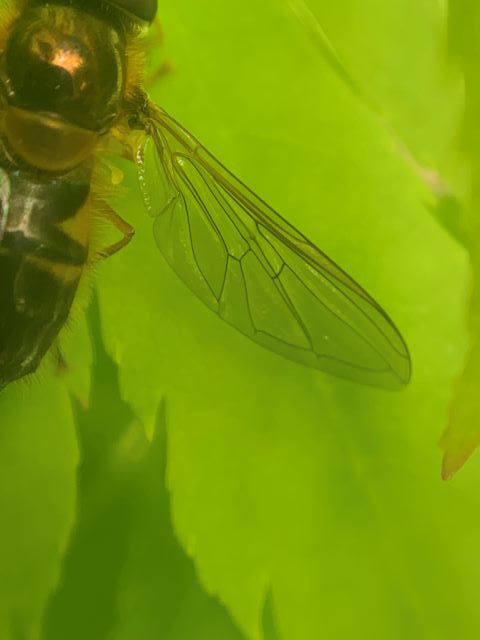
It turns out to be a species called Epistrophe eligans. We’ve probably been overlooking this common species all along, thinking it to be Eristalis pertinax which looks similar.
So we ended the day with our 24th species from the Family Syrphidae (Hoverflies), and no doubt there will be other species recorded in the future.
Hoverflies are a simple way to begin to explore a garden’s biodiversity as they are mostly recognizable as hoverflies and generally easy to capture or photograph. Many can be identified to species level with little difficulty, more with a little practice. There are a number of very good books available to help with identification, our favourite being:
Ball, S & Morris, R. (2015)Britain’s Hoverflies A field guide. Oxfordshire: Princeton University Press
Attracting passing adult hoverflies requires nothing more than a food source. In the USA Hoverflies are known as Flower Flies, and for very good reason. Suitable flowers are generally ones where the nectar is easy to get to without the need for a long proboscis (which flies lack). Wild Carrot, Oxeye Daisy, and Green Alkanet are native flowers that can be used to attract them. California Lilac is a good non-native shrub that isn’t (yet) invasive and attracts good numbers also.
The larvae feed on many different things, but many are aphid feeders, so plants like Hazel which attract large numbers of aphids are a good bet.
DC: 14.04.2024
 Wildlife Garden