We recently recovered a small petri dish mistakenly left outside for several months gathering rain. Rather than just wash it out we decided first to see what had colonised the dish during this time.
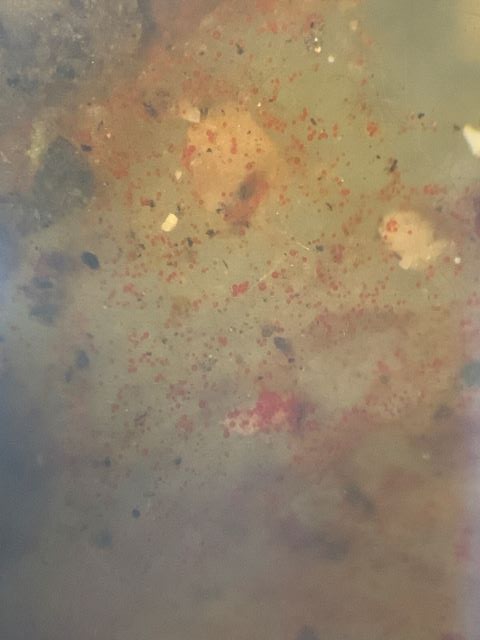
We could already see that lots of algae had formed throughout the dish. Lots of detritus had also arrived as well. But to get a really good look would require magnification…
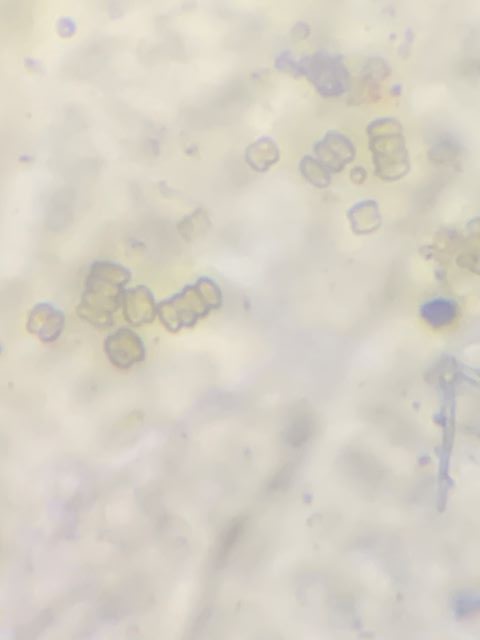
Under magnification (x100), we could see the individual algae cells. In this case a green algae which mainly appeared in sets of 4 cells, sometimes fewer but never more. This is somewhat similar to a species called Scenedesmus quadricuada.
However, it was the unexpected drama we uncovered in the video clip below that made us start to think about water and in particular surface water tension and its effects on small creatures.
In this clip the larger animal, initially feeding on the dead Springtail, is an Oribatid Mite (species unknown). Most Oribatids are not active hunters, prefering to feed on fungi, bacteria and carrion in the upper soil where they are usually found. A few species are known to be predators, but perhaps in the clip below this behaviour is more a result of the mite being trapped by the water tension around it. Forcing it to feed on whatever it could find.
The second ‘live’ invertebrate is another Springtail (species unknown). It too is clearly trapped. The mite and the sprintail joined together by water tension, where one goes the other is drawn also.
If you watch the clip to the end, then clearly the Oribatid is attempting to predate the live sprintail. And is almost succesful until, in a last ditch effort, the Springtail somehow breaks free of its hydological bound with the Mite.
This mini drama highlights well the often different universe miniature creatures live in. Where a rain drop hit can pose a significant threat. Where a heat wave/ drought actually can mean dessication. And in this case where something as simply as hydrogen bonds can trap those not adapted to aquatic habitats.
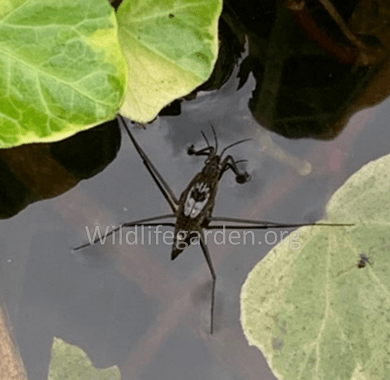
Obviously water surface tension is just a fact of life, one that many species like our friend the water skater takes full advantage of. Indeed, without this property of water, capillary action wouldnt be possible and vascular plants would not exist in the forms we are familiar with.
Fresh water habitats are a haven for many forms of life and conversley a hazard to many non-adapted species. The above drama is likely reinacted countless times every day in the Garden. We are posting about it purely as a topic of interest.
All we can really do as gardeners is to ensure our artificial freshwater habitats and containers don’t pose a risk to larger animals. We all know that ponds should have gently sloping sides anyway. Where this is not possible, for example, our fish pond, then an escape ramp is a must. Remember also that water butts should always have a secure lid.
DC – 28/12/2023
 Wildlife Garden